 Back
BackSolutions and Solution Concentration: Mass, Volume, and Mass/Volume Percent
Study Guide - Smart Notes
 Tailored notes based on your materials, expanded with key definitions, examples, and context.
Solutions
Introduction to Solutions
Solutions are homogeneous mixtures composed of two or more substances. The substance present in the largest amount is called the solvent, while the other substances are called solutes. Understanding how to express the concentration of solutions is essential in chemistry, especially in laboratory and clinical settings.
Solution Concentration
Units of Concentration
The concentration of a solution describes the amount of solute dissolved in a specific amount of solution. Common units of concentration include:
Mass percent (m/m)
Volume percent (v/v)
Mass/volume percent (m/v)
These units are used to quantify how much solute is present relative to the total solution, which is crucial for preparing solutions with precise properties.
Mass Percent (m/m)
Definition and Calculation
Mass percent (m/m) expresses the mass of solute in 100 grams of solution. It is calculated using the formula:
Alternatively, it can be used as a conversion factor:
Example Calculation
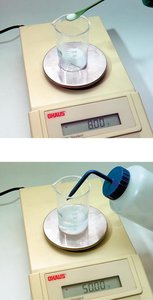
When 8.00 g of KCl is dissolved in water to make 50.00 g of solution, the mass percent is:
Stepwise Calculation Example
For a solution prepared by mixing 15.0 g of Na2CO3 and 235 g of H2O:
Calculate total mass of solution: 15.0 g + 235 g = 250.0 g
Calculate mass percent:
Clinical Application
Medications are often described using mass percent. For example, a 0.1% (m/m) ointment contains 0.1 g of active ingredient per 100 g of ointment. This allows precise dosing in pharmaceutical preparations.
Using Mass Percent as a Conversion Factor
To find the amount of solute in a given mass of solution, use the mass percent as a conversion factor. For example, in 375 g of a 2.0% (m/m) NaCl solution:
Volume Percent (v/v)
Definition and Calculation
Volume percent (v/v) expresses the volume of solute in 100 mL of solution. It is calculated as:
Or as a conversion factor:
Example Calculation
To prepare a 5.75% (v/v) ethanol solution from 2.25 mL of ethanol:

Application Example
To find the amount of bleach in a 320-mL bottle labeled as a 7.5% bleach solution:
Mass/Volume Percent (m/v)
Definition and Calculation
Mass/volume percent (m/v) expresses the mass of solute in 100 mL of solution. It is calculated as:
Or as a conversion factor:
Example Calculation
If a patient receives 125 mL of a 20% (m/v) mannitol solution, the mass of mannitol administered is:
Determining Solution Volume for a Given Solute Mass
To provide 135 g of glucose using a 5% (m/v) glucose solution:
Conversion Factors from Percent Concentrations
Examples of Conversion Factors
Solution | Conversion Factor 1 | Conversion Factor 2 |
|---|---|---|
8.50% (m/m) NaOH | 8.50 g NaOH / 100 g solution | 100 g solution / 8.50 g NaOH |
5.75% (v/v) ethanol | 5.75 mL ethanol / 100 mL solution | 100 mL solution / 5.75 mL ethanol |
4.8% (m/v) HCl | 4.8 g HCl / 100 mL solution | 100 mL solution / 4.8 g HCl |
Summary Table: Percent Concentration Formulas
Type | Formula | Interpretation |
|---|---|---|
Mass percent (m/m) | g solute per 100 g solution | |
Volume percent (v/v) | mL solute per 100 mL solution | |
Mass/volume percent (m/v) | g solute per 100 mL solution |
Additional info: These concentration units are foundational for preparing laboratory solutions, calculating dosages in medicine, and analyzing chemical mixtures in both academic and professional settings.
