Back
BackSolutions and Their Properties: Structure, Solubility, and Biological Relevance 8
Study Guide - Smart Notes
 Tailored notes based on your materials, expanded with key definitions, examples, and context.
Solutions and Mixtures
Types of Mixtures
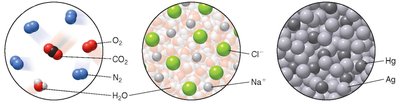
Most substances encountered in daily life are mixtures of two or more pure substances. Mixtures can be classified as heterogeneous (non-uniform composition) or homogeneous (uniform composition throughout). A solution is a homogeneous mixture containing small particles, while a colloid is a homogeneous mixture with larger particles, often appearing opaque.
Solute: Substance present in a lesser amount in a solution.
Solvent: Substance present in a larger amount in a solution.
Aqueous solution: Solution where water is the solvent.
Electrolytes and Nonelectrolytes
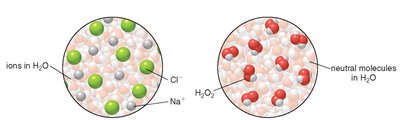
A substance that conducts electricity in water is called an electrolyte. Substances that do not conduct electricity in water are nonelectrolytes. For example, NaCl dissociates into ions in water, making it an electrolyte, while H2O2 does not dissociate and is a nonelectrolyte.
Solubility
General Features and Principles
Solubility is the amount of solute that dissolves in a given amount of solvent, typically expressed in grams per 100 mL of solution (g/100 mL). A saturated solution contains the maximum amount of solute that can dissolve, while an unsaturated solution contains less than this maximum.
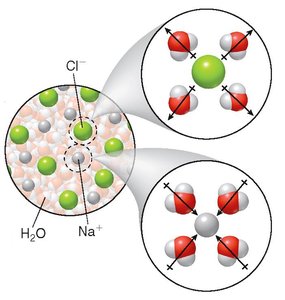
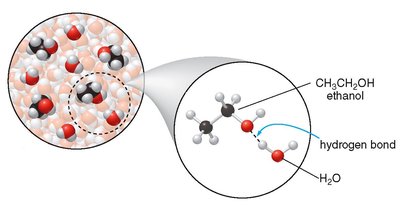
"Like dissolves like": Ionic and polar covalent compounds are generally soluble in water (a polar solvent).
Small neutral molecules with O or N atoms that can hydrogen bond to water are water soluble (e.g., ethanol).
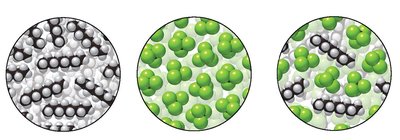
Nonpolar compounds are soluble in nonpolar solvents (e.g., octane in CCl4).
Energetics of Solution Formation
If solvation releases more energy than is required to separate particles, the process is exothermic (heat released).
If separation of particles requires more energy than is released during solvation, the process is endothermic (heat absorbed).
Solubility of Ionic Compounds
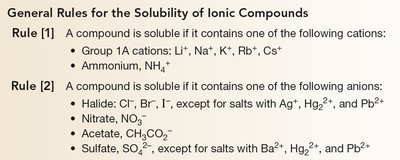
The solubility of ionic compounds in water follows general rules based on the ions present.
Effects of Temperature and Pressure on Solubility
Temperature Effects
For most ionic and molecular solids, solubility increases as temperature increases.
A supersaturated solution contains more solute than predicted at a given temperature.
For gases, solubility decreases as temperature increases.
Pressure Effects (Henry's Law)
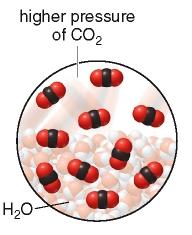
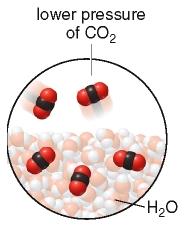
The solubility of a gas in a liquid is proportional to the partial pressure of the gas above the liquid (Henry's Law):
Higher pressure increases gas solubility in a solvent.
Concentration Units
Weight/Volume Percent (w/v)%
Weight/volume percent is the number of grams of solute per 100 mL of solution. For example, 5 g of acetic acid in 100 mL of solution is 5% (w/v).
Volume/Volume Percent (v/v)%
Volume/volume percent is the number of mL of solute per 100 mL of solution. For example, 70 mL of 2-propanol in 100 mL of solution is 70% (v/v).
Parts Per Million (ppm)
Very small concentrations are often expressed in parts per million (ppm).
Molarity (M)
Molarity is the number of moles of solute per liter of solution:
To calculate molarity from grams of solute, convert grams to moles using molar mass, and volume to liters if necessary.
To find moles or volume, rearrange the equation as needed.



Dilution of Solutions
Principle of Dilution
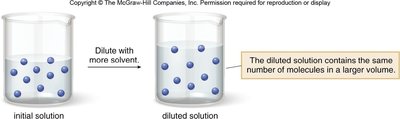
Dilution involves adding solvent to decrease the concentration of solute. The amount of solute remains constant, but the volume increases. The relationship is given by:
M1 and V1: Initial molarity and volume
M2 and V2: Final molarity and volume
Colligative Properties
Definition and Types
Colligative properties depend on the concentration of solute particles, not their identity. These include:
Boiling point elevation: Solutions with nonvolatile solutes have higher boiling points than pure solvents.
Freezing point depression: Solutions with nonvolatile solutes have lower freezing points than pure solvents.
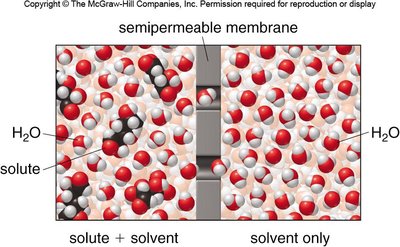
Osmotic pressure: Pressure required to prevent the flow of solvent into a solution through a semipermeable membrane.
For water:
1 mole of nonvolatile solute raises boiling point of 1 kg H2O by 0.51°C.
1 mole of nonvolatile solute lowers freezing point of 1 kg H2O by 1.86°C.
Osmosis and Dialysis
Osmosis
Osmosis is the movement of water across a semipermeable membrane from a region of low solute concentration to high solute concentration. The membrane allows water and small molecules to pass, but not ions or large molecules.
Osmotic Pressure and Tonicity
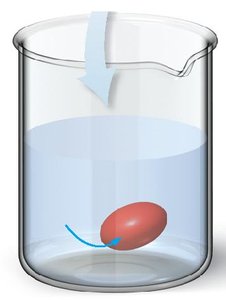
Isotonic solutions: Same osmotic pressure as body fluids (e.g., 0.92% NaCl, 5.0% glucose).
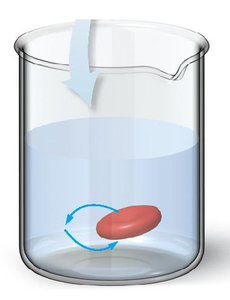
Hypotonic solutions: Lower osmotic pressure than body fluids; water enters cells, causing swelling and possible rupture (hemolysis in red blood cells).
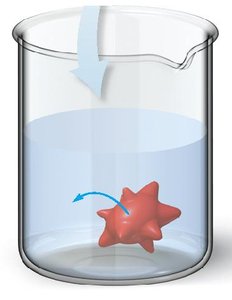
Hypertonic solutions: Higher osmotic pressure than body fluids; water leaves cells, causing shrinkage (crenation).
Dialysis
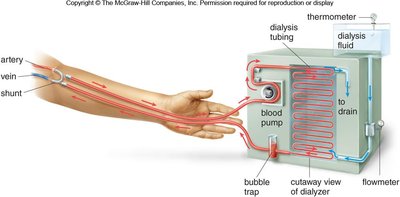
Dialysis is the process by which water, small molecules, and ions pass through a semipermeable (dialyzing) membrane, but large biological molecules (proteins, starch) cannot. This is the principle behind kidney function and hemodialysis, which removes waste products like urea from the blood when kidneys fail.