 Back
BackSolutions: Properties, Types, and Biological Relevance
Study Guide - Smart Notes
 Tailored notes based on your materials, expanded with key definitions, examples, and context.
Solutions
Definition and Components
Solutions are homogeneous mixtures composed of two or more substances. They form when there is sufficient attraction between the solute and solvent molecules. The two main components of a solution are:
Solvent: The substance present in the greater amount.
Solute: The substance present in the lesser amount.
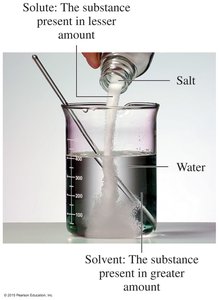
Example: In a saltwater solution, water is the solvent and salt is the solute.
Formation of Solutions
Solutions form when solute particles disperse evenly among solvent molecules, resulting in a uniform mixture.
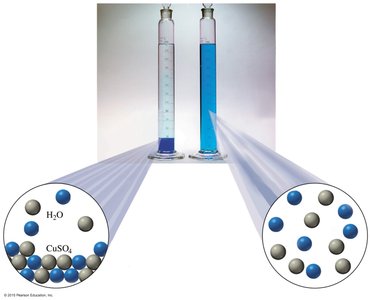
Example: Copper(II) sulfate (CuSO4) dissolves in water, with solute particles evenly distributed among water molecules.
Types of Solutes and Solvents
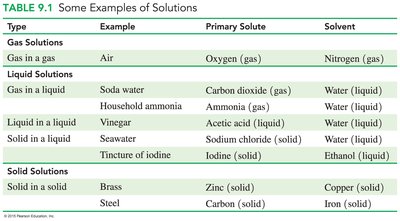
Solutes and solvents can be gases, liquids, or solids, leading to various types of solutions.
Type | Example | Primary Solute | Solvent |
|---|---|---|---|
Gas in a gas | Air | Oxygen (gas) | Nitrogen (gas) |
Gas in a liquid | Soda water | CO2 (gas) | Water (liquid) |
Liquid in a liquid | Vinegar | Acetic acid (liquid) | Water (liquid) |
Solid in a liquid | Seawater | Sodium chloride (solid) | Water (liquid) |
Solid in a solid | Brass | Zinc (solid) | Copper (solid) |
Water as a Solvent
Properties of Water
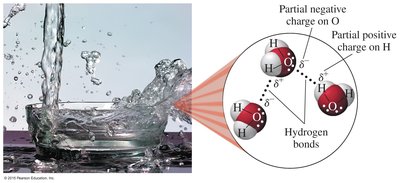
Water is one of the most common solvents in nature due to its polarity. The polar O—H bonds in water molecules allow them to form hydrogen bonds, which are crucial in dissolving many biological compounds.
Solubility Principles
Like Dissolves Like
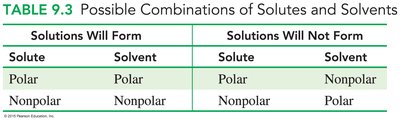
Solutions form most readily when the solute and solvent have similar polarities. This is summarized by the rule: "like dissolves like".
Solutions Will Form | Solutions Will Not Form |
|---|---|
Polar solute + Polar solvent | Polar solute + Nonpolar solvent |
Nonpolar solute + Nonpolar solvent | Nonpolar solute + Polar solvent |
Solutions with Ionic Solutes
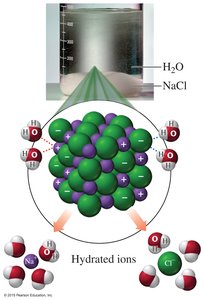
Ionic compounds such as NaCl dissolve in water through a process called hydration, where water molecules surround each ion and pull it into solution.
Solutions with Polar Solutes
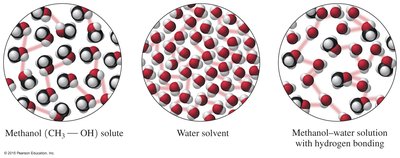
Polar molecular compounds, such as methanol (CH3OH), are soluble in water because they can form hydrogen bonds with water molecules. Polar solutes require polar solvents for a solution to form.
Electrolytes and Nonelectrolytes
Strong Electrolytes
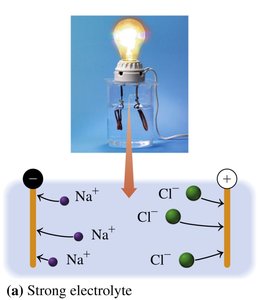
Strong electrolytes dissociate completely in water, producing ions that conduct electricity efficiently.

Weak Electrolytes
Weak electrolytes dissociate only partially in water, resulting in a solution with a few ions and mostly undissociated molecules.
Nonelectrolytes
Nonelectrolytes dissolve as molecules in water but do not produce ions and therefore do not conduct electricity.

Electrolytes in Biological Systems
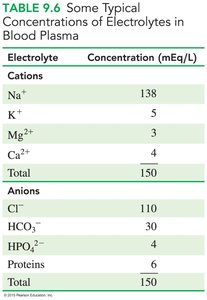
Electrolyte Concentrations in Blood Plasma
Electrolytes in body fluids maintain charge balance and are essential for physiological functions. Their concentrations are typically measured in milliequivalents per liter (mEq/L).
Equivalents and Milliequivalents
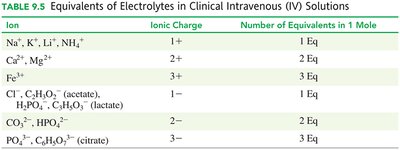
An equivalent (Eq) is the amount of an electrolyte that provides 1 mole of electrical charge. The number of equivalents depends on the ionic charge.
Ion | Ionic Charge | Number of Equivalents in 1 Mole |
|---|---|---|
Na+, K+, Li+, NH4+ | 1+ | 1 Eq |
Ca2+, Mg2+ | 2+ | 2 Eq |
Fe3+ | 3+ | 3 Eq |
Cl-, CH3COO- | 1- | 1 Eq |
CO32-, HPO42- | 2- | 2 Eq |
PO43- | 3- | 3 Eq |
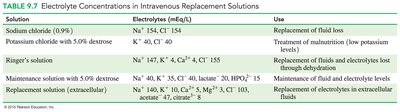
Electrolytes in IV Solutions
Intravenous (IV) solutions are formulated to match the electrolyte needs of patients, ensuring proper fluid and electrolyte balance.
Solubility
Definition of Solubility
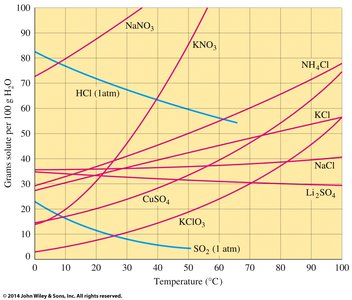
Solubility is the maximum amount of solute that can dissolve in 100 g of solvent at a specific temperature. Solubility varies with temperature and the nature of the solute and solvent.
Saturated and Unsaturated Solutions
A saturated solution contains the maximum amount of solute that can dissolve at a given temperature. An unsaturated solution contains less solute than the maximum amount possible.
Concentration Units
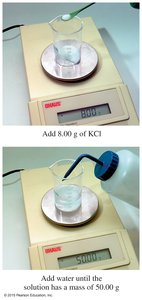
Mass Percent (% m/m)
Mass percent expresses the concentration as grams of solute per 100 g of solution.
Volume Percent (% v/v)
Volume percent is the volume of solute per 100 mL of solution, commonly used for liquid-liquid solutions.
Mass/Volume Percent (% m/v)
Mass/volume percent is the mass of solute (g) per 100 mL of solution, often used in medical and laboratory settings.
Molarity (M)
Molarity is defined as the number of moles of solute per liter of solution.
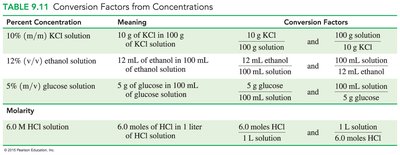
Conversion Factors from Concentrations
Concentration units can be used as conversion factors in calculations involving solutions.
Dilution of Solutions
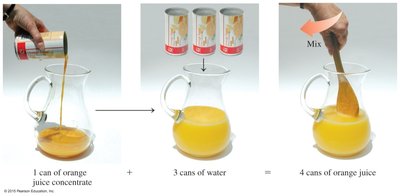
Principle of Dilution
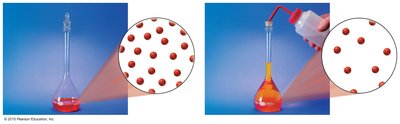
Dilution involves adding solvent to a solution, increasing its volume and decreasing its concentration, while the amount of solute remains constant.
Mathematical Relationship in Dilution
The relationship between the initial and final concentrations and volumes is given by:
or, for molarity:
Osmosis and Osmotic Pressure
Osmosis
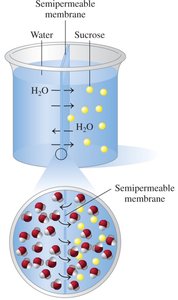
Osmosis is the movement of water across a semipermeable membrane from a region of lower solute concentration to higher solute concentration, equalizing concentrations on both sides.
Osmotic Pressure
Osmotic pressure is the pressure required to prevent the flow of additional water into the more concentrated solution. It increases with the number of dissolved particles.
Isotonic, Hypotonic, and Hypertonic Solutions
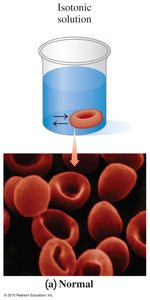
Isotonic Solution: Exerts the same osmotic pressure as body fluids; red blood cells retain their normal volume.
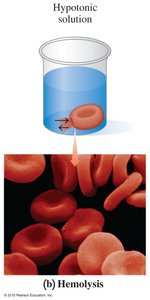
Hypotonic Solution: Has a lower solute concentration than body fluids; water enters cells, causing them to swell and burst (hemolysis).
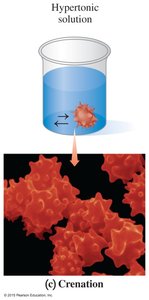
Hypertonic Solution: Has a higher solute concentration than body fluids; water leaves cells, causing them to shrink (crenation).
Dialysis
Principle of Dialysis
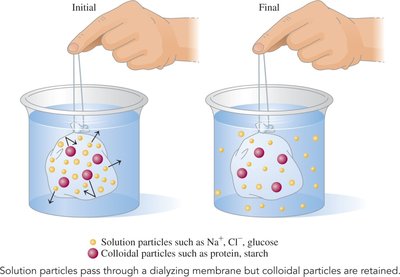
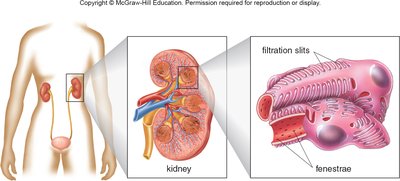
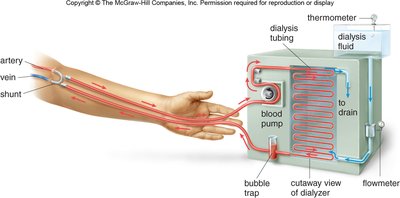
Dialysis is a process where solvent and small solute particles pass through an artificial membrane, while large particles are retained. This is used in medical treatments such as hemodialysis to remove waste products from the blood.
Additional info: The notes above include expanded explanations, definitions, and examples to ensure completeness and academic quality for exam preparation.
