 Back
BackSolutions: Properties, Types, and Calculations
Study Guide - Smart Notes
 Tailored notes based on your materials, expanded with key definitions, examples, and context.
Introduction to Solutions
Definition and Classification
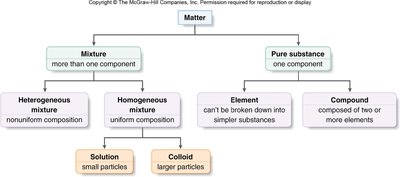
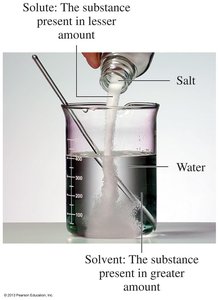
Solutions are homogeneous mixtures composed of two or more substances. In a solution, the solute is the substance present in a lesser amount and is uniformly dispersed within the solvent, which is present in a greater amount. Solutions are a fundamental concept in chemistry, especially in the study of chemical reactions and properties of matter.
Components of Solutions
Solute and Solvent
The solute is the substance that is dissolved, while the solvent is the substance that does the dissolving. In aqueous solutions, water is the solvent. The solute is typically present in a smaller amount and may not be visible, but it can impart color to the solution.
Examples of Solutions
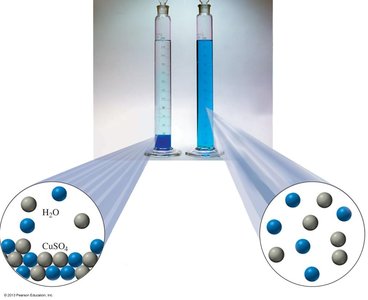
Common examples include sodium chloride (NaCl) dissolved in water and bromine (Br2) dissolved in water. In both cases, water acts as the solvent.
Properties of Water as a Solvent
Water: The Universal Solvent
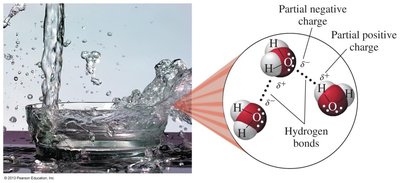
Water is known as the universal solvent due to its ability to dissolve a wide variety of substances. It is a polar molecule and forms hydrogen bonds between the partially positive hydrogen atom of one molecule and the partially negative oxygen atom of another.
Formation of Solutions
Like Dissolves Like
For a solution to form, the solute and solvent must have similar polarities. Polar solvents dissolve polar or ionic solutes, while nonpolar solvents dissolve nonpolar solutes. The energy of interaction between solute and solvent particles must be sufficient to overcome the forces holding the solute and solvent together.
Solutions with Ionic and Polar Solutes
When ionic compounds like NaCl dissolve in water, the ions are attracted to the polar water molecules and become hydrated, dispersing throughout the solution.
Solutions with Polar Solutes
Polar covalent compounds, such as methanol (CH3OH), form hydrogen bonds with water, resulting in a homogeneous solution.
Solubility
Definition and Factors Affecting Solubility
Solubility is the amount of solute that can dissolve in a given amount of solvent at a specific temperature. For example, NaCl is highly soluble in water, while copper metal is not.
Saturated and Unsaturated Solutions
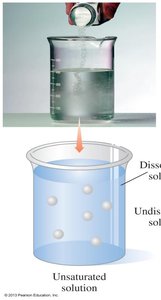
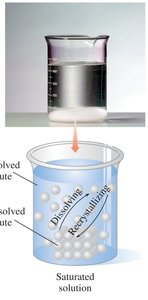
A saturated solution contains the maximum amount of solute that can dissolve at a given temperature. An unsaturated solution contains less than this maximum amount.
Effect of Temperature on Solubility
The solubility of most solids increases with temperature, while the solubility of gases decreases as temperature increases. This explains why carbonated drinks may burst when left in the sun, as the dissolved gas escapes more readily at higher temperatures.
Effect of Pressure on Solubility
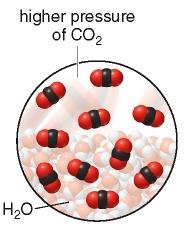
According to Henry's Law, the solubility of a gas in a liquid is proportional to the partial pressure of the gas above the liquid. Higher pressure increases gas solubility.
Solubility Rules and Precipitation
Soluble and Insoluble Salts
Ionic compounds that dissolve in water are called soluble salts, while those that do not are insoluble salts. Mixing certain aqueous solutions can produce insoluble salts, resulting in precipitation.
Solubility Rules
Solubility rules help predict whether an ionic compound will dissolve in water. For example, all compounds containing Group 1A cations or ammonium are soluble, while most compounds containing hydroxide are insoluble except with Group 1A metals or larger Group 2A metals.
Predicting Products and Net Ionic Equations
Predicting Products of Chemical Reactions
To predict the products of a reaction, separate all compounds into ions, crisscross partners, balance the compounds, and determine the phase using solubility rules.
Types of Equations
Molecular Equation: Shows all reactants and products as compounds.
Full Ionic Equation: Shows all strong electrolytes as ions.
Net Ionic Equation: Shows only the species that actually participate in the reaction.
Steps for Writing Net Ionic Equations
Determine the phases of all reactants and products.
Dissociate all aqueous compounds into ions.
Cancel spectator ions.
Rewrite the equation with only reactive ions/compounds.
Balance the equation.
Acids, Bases, and Electrolytes
Acids and Bases
Acids produce H+ (or H3O+) in solution, while bases produce OH-. Strong acids and bases dissociate completely, while weak acids and bases do not.
Electrolytes
An electrolyte is a compound that conducts electricity when dissolved in water. Strong electrolytes dissociate completely, weak electrolytes only partially, and non-electrolytes do not conduct electricity at all.
Solution Concentration Calculations
Molarity (M)
Molarity is the number of moles of solute per liter of solution. It is calculated as:
Dilution Calculations
When diluting a solution, the amount of solute remains constant. The relationship is given by:
where M is molarity and V is volume.
Mass Percent, Volume Percent, and Mass/Volume Percent
Mass percent (m/m):
Volume percent (v/v):
Mass/Volume percent (m/v):
Solution Stoichiometry and Titration Calculations
Stoichiometry in solutions involves using balanced chemical equations to relate concentrations and volumes of reactants and products. Titration is a technique to determine the concentration of an unknown solution by reacting it with a solution of known concentration.
Summary Table: Types of Mixtures and Solutions
Type | Definition | Example |
|---|---|---|
Homogeneous Mixture (Solution) | Uniform composition throughout | Salt water |
Heterogeneous Mixture | Non-uniform composition | Sand in water |
Colloid | Intermediate particle size | Milk |
Suspension | Large particles, settle out | Muddy water |
