 Back
BackSolutions, Solubility, and Acids & Bases: Key Concepts and Calculations
Study Guide - Smart Notes
 Tailored notes based on your materials, expanded with key definitions, examples, and context.
Solutions and Solubility
Formation of Solutions
Solutions are homogeneous mixtures composed of a solute dissolved in a solvent. The ability of substances to form solutions depends on their chemical nature, particularly polarity and intermolecular forces.
Like dissolves like: Polar solutes dissolve in polar solvents; nonpolar solutes dissolve in nonpolar solvents.
Example: Benzene (C6H6) and hexane (C6H14) are both nonpolar and will form a solution.
Solubility of Ionic Compounds
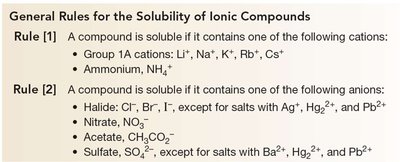
The solubility of ionic compounds in water is governed by specific rules based on the ions present.
Soluble cations: Group 1A ions (Li+, Na+, K+, Rb+, Cs+) and NH4+
Soluble anions: NO3-, CH3COO-, and most halides (Cl-, Br-, I-), except with Ag+, Hg22+, Pb2+
Sulfates (SO42-): Soluble except with Ba2+, Hg22+, Pb2+
Factors Affecting Solubility
Several factors influence the solubility of a solute in a solvent:
Temperature: Increasing temperature generally increases the solubility of solids in liquids.
Pressure: Increasing pressure increases the solubility of gases in liquids (Henry's Law).
Concentration Units
Concentration expresses the amount of solute in a given quantity of solution. Common units include:
Weight/Volume Percent (w/v)%:
Parts per million (ppm):
Molarity (M):
Dilution Calculations
To dilute a solution, use the equation:
Example: To dilute a 0.700 M solution to 0.140 M in a final volume of 15 mL, solve for the volume of concentrated solution needed and subtract from 15 mL to find the volume of water to add.
Colligative Properties
Colligative properties depend on the number of solute particles in solution, not their identity.
Boiling Point Elevation: Solutions have higher boiling points than pure solvents.
Freezing Point Depression: Solutions have lower freezing points than pure solvents.
Vapor Pressure Lowering: Solutions have lower vapor pressure than pure solvents.
Osmosis and Tonicity
Osmosis is the movement of solvent through a semipermeable membrane from low to high solute concentration.
Hypotonic solution: Lower osmotic pressure than body fluids.
Hypertonic solution: Higher osmotic pressure than body fluids.
Isotonic solution: Same osmotic pressure as body fluids.
Acids, Bases, and Buffers
Acid-Base Definitions
Acids and bases can be defined in several ways:
Arrhenius: Acids produce H+ in water; bases produce OH-.
Brønsted-Lowry: Acids donate protons (H+); bases accept protons.
Strong and Weak Acids/Bases
Strong acids: HI, HBr, HCl, H2SO4, HNO3
Strong bases: LiOH, NaOH, KOH, Ca(OH)2, Ba(OH)2
Weak acids/bases: Partially ionize in water (e.g., HF, CH3COOH)
Acid and Base Strength (Ka and Kb)
The strength of an acid is measured by its acid dissociation constant (Ka):
Larger Ka: Stronger acid
pH and pOH Calculations
at 25°C
Relationship:
Conjugate Acid-Base Pairs
When an acid donates a proton, it forms its conjugate base; when a base accepts a proton, it forms its conjugate acid.
Example: HS- (base) + H+ → H2S (conjugate acid)
Buffer Solutions
Buffers are solutions that resist changes in pH when small amounts of acid or base are added. They are made from a weak acid and its conjugate base (or a weak base and its conjugate acid).
Example: CH3COOH and NaCH3COO
Buffer pH calculation (Henderson-Hasselbalch equation):
Titration Calculations
Titration is used to determine the concentration of an unknown acid or base by reacting it with a standard solution.
Example equation: KOH(aq) + HCl(aq) → H2O(l) + KCl(aq)
Use for calculations when the reaction is 1:1.
Naming Acids
HNO2: Nitrous acid
HNO3: Nitric acid
Salts and Solution pH
Salts can form acidic, basic, or neutral solutions depending on the strengths of the parent acid and base.
Example: Na3PO4 forms a basic solution in water.
Summary Table: Common Solution Calculations
Calculation | Formula |
|---|---|
Weight/Volume % (w/v)% | |
Parts per million (ppm) | |
Molarity (M) | |
Dilution | |
Acid Dissociation Constant (Ka) | |
Water Ion Product (Kw) | |
pH |
Additional info: This guide covers key concepts from solutions, solubility, and acids/bases, including calculations and definitions relevant for introductory college chemistry (Ch. 8 and Ch. 9).
