 Back
States of Matter and Their Attractive Forces: Gas Laws, Solubility, and Applications to the Cell Membrane
Study Guide - Smart Notes
 Tailored notes based on your materials, expanded with key definitions, examples, and context.
States of Matter and Their Attractive Forces
Particle-Level Description of Gases and Phase Changes
The states of matter—solid, liquid, and gas—are defined by the arrangement and movement of their particles. A phase change, such as liquid to gas (evaporation), is a physical change because the chemical identity of the substance remains the same, but the arrangement and energy of the particles change.
Physical Change: Alters the state or appearance without changing the chemical composition.
Chemical Change: Results in the formation of new substances.
Evaporation: Water molecules gain enough kinetic energy to escape the liquid phase and become gas.
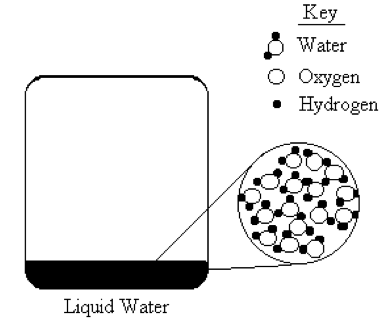
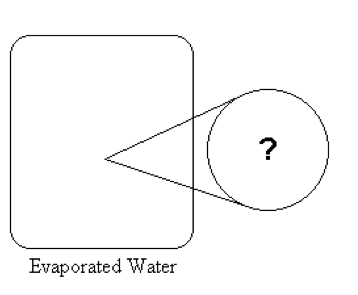
Example: When water evaporates, the molecules are still H2O, but they are farther apart and move more freely in the gas phase.
Density of Gases
Gases have much lower density than solids or liquids because their particles are far apart. This property explains phenomena such as helium balloons floating due to density differences between helium and air.
Density: Mass per unit volume; gases are less dense because their particles occupy more space.
Helium Balloons: Helium is less dense than air, causing balloons to rise.
Common Gases and Their Properties
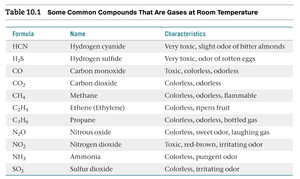
Many molecular compounds are gases at room temperature, especially those composed of nonmetals and with low molar mass. Elements such as He, Ne, Ar, Kr, Xe (monatomic) and H2, N2, O2, F2, Cl2 (diatomic) are common gases.
Monatomic Gases: Noble gases (He, Ne, Ar, Kr, Xe)
Diatomic Gases: H2, N2, O2, F2, Cl2
Weak Intermolecular Forces: Allow these substances to exist as gases under standard conditions.
Properties of Gases: Pressure and Measurement
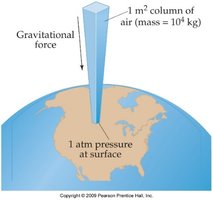
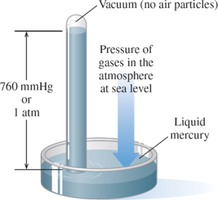
Gas pressure is the force exerted by gas particles against the walls of their container. Atmospheric pressure is the weight of air per unit area on Earth's surface.
Pressure Units: atm, torr, mmHg, psi, Pa
Standard Atmospheric Pressure: 1 atm = 760 mmHg = 760 torr = 1.01325 x 10⁵ Pa = 14.70 psi
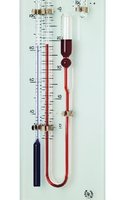
Barometer: Instrument used to measure atmospheric pressure.
Gas Laws
The named gas laws describe relationships between pressure, volume, temperature, and amount of gas:
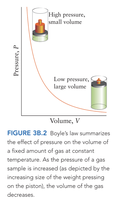
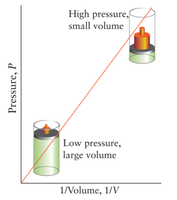
Boyle's Law: At constant temperature, volume is inversely proportional to pressure.
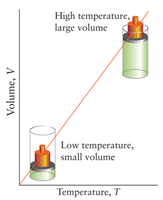
Charles' Law: At constant pressure, volume is directly proportional to temperature (in Kelvin).
Gay-Lussac's Law: At constant volume, pressure is directly proportional to temperature.
Avogadro's Law: At constant temperature and pressure, volume is directly proportional to the number of moles.
Ideal Gas Law:
Kinetic Molecular Theory of Gases
The kinetic molecular theory explains the behavior of gases based on the motion and energy of their particles:
Gas particles are far apart; most of the volume is empty space.
Particles are in constant, random motion.
No attractive forces between particles.
Kinetic energy is proportional to absolute temperature.
States of Matter: Properties and Comparison
The state a substance adopts depends on the balance between kinetic energy and attractive forces (intermolecular forces, IMFs). Solids have the strongest IMFs, liquids have moderate IMFs, and gases have the weakest.
Solids: Definite shape and volume, high density, strong IMFs
Liquids: Definite volume, no definite shape, moderate density, moderate IMFs
Gases: No definite shape or volume, low density, weak IMFs
Changes of State
Substances change state when energy is added or removed, affecting the kinetic energy and overcoming or reinforcing IMFs.
Melting: Solid to liquid
Boiling/Evaporation: Liquid to gas
Condensation: Gas to liquid
Freezing: Liquid to solid
Boiling and Vapor Pressure
Boiling occurs when the vapor pressure of a liquid equals atmospheric pressure. Vapor pressure is the pressure exerted by molecules escaping from the liquid phase into the gas phase.
Boiling Point: Temperature at which vapor pressure equals atmospheric pressure.
Vapor Pressure: Characteristic of each substance, increases with temperature.
Intermolecular Forces (IMFs)
IMFs are electrostatic attractions between molecules, weaker than chemical bonds but crucial for determining physical properties.
London Dispersion Forces: Present in all molecules, especially nonpolar; increase with molar mass and surface area.
Dipole-Dipole Interactions: Occur in polar molecules due to permanent dipoles.
Hydrogen Bonding: Strong dipole-dipole interaction; requires H bonded to N, O, or F and a lone pair on N, O, or F.
Ion-Dipole Interactions: Occur between ions and polar molecules; important in solutions.
Ion-Ion Interactions: Strongest; occur between two ionic compounds.
IMFs and Physical Properties
Stronger IMFs result in higher boiling points, melting points, and lower vapor pressures.
Boiling Point: Increases with stronger IMFs.
Vapor Pressure: Decreases with stronger IMFs.
Solubility: "Like dissolves like"—polar solutes dissolve in polar solvents, nonpolar in nonpolar.
IMFs and Solubility
Solubility depends on the types of IMFs present. Polar substances are hydrophilic and dissolve in water; nonpolar substances are hydrophobic and do not.
Hydrophilic: Water-loving, polar, can hydrogen bond.
Hydrophobic: Water-fearing, nonpolar, cannot hydrogen bond.
Dietary Lipids: Fats and Oils
Fats and oils are triglycerides, differing in their degree of saturation and physical state at room temperature.
Fats: Derived from animals, solid at room temperature, straight-chain tails allow strong IMFs.
Oils: Derived from plants, liquid at room temperature, cis double bonds create kinks, weaker IMFs.
Cell Membrane Structure
Cell membranes are composed of phospholipids, which form a bilayer due to their amphipathic nature (hydrophilic head, hydrophobic tails). Cholesterol and proteins are also key components.
Phospholipids: Two fatty acid tails, phosphate-containing head, form bilayer.
Cholesterol: Regulates membrane fluidity.
Proteins: Functional components, allow transport and signaling.
Summary Table: Types of Intermolecular Forces
Type of IMF | Look For | Relative Strength |
|---|---|---|
London Dispersion | Nonpolar molecules, large MM/surface area | Weakest |
Dipole-Dipole | Polar molecules | Moderate |
Hydrogen Bonding | H bonded to N/O/F, lone pair on N/O/F | Strong (biological importance) |
Ion-Dipole | Ionic compound + polar solvent | Stronger than H-bond |
Ion-Ion | Two ionic compounds | Strongest |
Additional info: The notes cover all major aspects of Chapter 7, including gas laws, kinetic molecular theory, IMFs, solubility, dietary lipids, and cell membrane structure, with relevant images included to reinforce key concepts.
