 Back
BackStep-by-Step Guidance for GOB College Exam Review: Carbohydrates, Lipids, Amino Acids, and Enzymes
Study Guide - Smart Notes
 Tailored notes based on your materials, expanded with key definitions, examples, and context.
Q1. Which carbohydrate(s) bond present are used for energy storage in humans?
Background
Topic: Carbohydrate Structure and Function
This question tests your understanding of the types of glycosidic bonds found in carbohydrates and their role in energy storage in humans.
Key Terms:
Carbohydrate: Organic molecules made of sugar units (monosaccharides).
Glycosidic bond: The covalent bond that links monosaccharides together in polysaccharides.
Energy storage: Refers to how carbohydrates are stored and used for energy in the body (e.g., glycogen).
Step-by-Step Guidance
Recall the main carbohydrate used for energy storage in humans (glycogen).
Identify the types of glycosidic bonds present in glycogen (typically α-1,4 and α-1,6).
Review the structural differences between α and β glycosidic bonds and their biological significance.
Consider which bonds are found in starch and cellulose, and why only certain bonds are used for energy storage in humans.
Try solving on your own before revealing the answer!
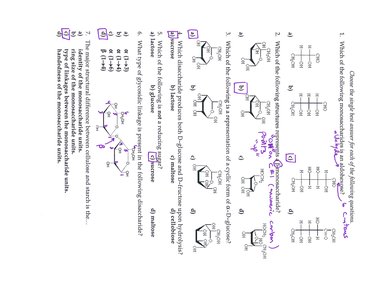
Q2. Which of the following structures is a representation of the cyclic form of D-glucose?
Background
Topic: Monosaccharide Structure
This question tests your ability to recognize the cyclic (ring) structure of D-glucose, a common monosaccharide.
Key Terms:
D-glucose: A six-carbon sugar (hexose) with a specific stereochemistry.
Cyclic form: The ring structure formed when the aldehyde or ketone group reacts with a hydroxyl group.
Haworth projection: A common way to represent cyclic sugars.
Step-by-Step Guidance
Recall the structure of D-glucose in its cyclic form (usually a six-membered ring, called a pyranose).
Identify the correct orientation of hydroxyl groups on the ring (especially at C1, C2, C3, C4, and C5).
Compare the given structures to the standard Haworth projection of D-glucose.
Check for the correct stereochemistry (D-configuration) at each chiral center.
Try solving on your own before revealing the answer!
Q3. Which disaccharide is composed of glucose and fructose?
Background
Topic: Disaccharide Composition
This question tests your knowledge of common disaccharides and their monosaccharide components.
Key Terms:
Disaccharide: A carbohydrate made of two monosaccharides joined by a glycosidic bond.
Glucose: A common monosaccharide.
Fructose: Another common monosaccharide.
Step-by-Step Guidance
Recall the names and compositions of common disaccharides (e.g., sucrose, lactose, maltose).
Identify which disaccharide contains both glucose and fructose.
Review the glycosidic bond type connecting glucose and fructose in this disaccharide.
Try solving on your own before revealing the answer!
Q4. Which of the following is a reducing sugar?
Background
Topic: Reducing Sugars
This question tests your understanding of what makes a sugar "reducing" and how to identify them.
Key Terms:
Reducing sugar: A sugar that has a free aldehyde or ketone group capable of acting as a reducing agent.
Monosaccharide: Simple sugars, often reducing.
Disaccharide: May or may not be reducing, depending on the glycosidic bond.
Step-by-Step Guidance
Recall the definition of a reducing sugar and the structural features required.
Identify which sugars have a free anomeric carbon (not involved in a glycosidic bond).
Review the structures of the sugars listed and determine if any have a free aldehyde or ketone group.
Try solving on your own before revealing the answer!
Q5. Which of the following is a correct representation of a Fischer projection of D-glucose?
Background
Topic: Fischer Projections
This question tests your ability to recognize the linear (open-chain) form of D-glucose using Fischer projection notation.
Key Terms:
Fischer projection: A two-dimensional representation of a molecule's stereochemistry.
D-glucose: A specific stereoisomer of glucose.
Step-by-Step Guidance
Recall the arrangement of hydroxyl groups in D-glucose's Fischer projection (right/left at each chiral center).
Compare the given projections to the standard D-glucose Fischer projection.
Check for the correct orientation at C2, C3, C4, and C5.
Try solving on your own before revealing the answer!
Q6. Which polysaccharide is used for energy storage in animals?
Background
Topic: Polysaccharide Function
This question tests your knowledge of the main polysaccharides and their biological roles.
Key Terms:
Polysaccharide: Large carbohydrate molecules made of many monosaccharide units.
Energy storage: Refers to how animals store carbohydrates for later use.
Step-by-Step Guidance
Recall the main polysaccharides found in animals (glycogen).
Identify the structural features of glycogen and how it differs from plant polysaccharides (e.g., starch, cellulose).
Review the biological function of glycogen in energy storage.
Try solving on your own before revealing the answer!
Q7. Which of the following is a correct representation of a cyclic form of D-galactose?
Background
Topic: Monosaccharide Structure
This question tests your ability to recognize the cyclic structure of D-galactose.
Key Terms:
D-galactose: A six-carbon sugar (hexose) with a specific stereochemistry.
Cyclic form: The ring structure formed when the aldehyde group reacts with a hydroxyl group.
Step-by-Step Guidance
Recall the structure of D-galactose in its cyclic form (usually a six-membered ring).
Identify the correct orientation of hydroxyl groups on the ring (especially at C4, which distinguishes galactose from glucose).
Compare the given structures to the standard Haworth projection of D-galactose.
Try solving on your own before revealing the answer!
Q8. Which of the following is a correct representation of a Fischer projection of D-galactose?
Background
Topic: Fischer Projections
This question tests your ability to recognize the linear form of D-galactose using Fischer projection notation.
Key Terms:
Fischer projection: A two-dimensional representation of a molecule's stereochemistry.
D-galactose: A specific stereoisomer of galactose.
Step-by-Step Guidance
Recall the arrangement of hydroxyl groups in D-galactose's Fischer projection (especially at C4).
Compare the given projections to the standard D-galactose Fischer projection.
Check for the correct orientation at each chiral center.
Try solving on your own before revealing the answer!
Q9. Which of the following is a correct representation of a cyclic form of D-fructose?
Background
Topic: Monosaccharide Structure
This question tests your ability to recognize the cyclic structure of D-fructose.
Key Terms:
D-fructose: A six-carbon sugar (hexose) with a ketone group.
Cyclic form: The ring structure formed when the ketone group reacts with a hydroxyl group.
Step-by-Step Guidance
Recall the structure of D-fructose in its cyclic form (usually a five-membered ring, called a furanose).
Identify the correct orientation of hydroxyl groups on the ring.
Compare the given structures to the standard Haworth projection of D-fructose.
Try solving on your own before revealing the answer!
Q10. Which of the following is a correct representation of a Fischer projection of D-fructose?
Background
Topic: Fischer Projections
This question tests your ability to recognize the linear form of D-fructose using Fischer projection notation.
Key Terms:
Fischer projection: A two-dimensional representation of a molecule's stereochemistry.
D-fructose: A specific stereoisomer of fructose.
Step-by-Step Guidance
Recall the arrangement of hydroxyl groups in D-fructose's Fischer projection (especially at C2, the ketone carbon).
Compare the given projections to the standard D-fructose Fischer projection.
Check for the correct orientation at each chiral center.
Try solving on your own before revealing the answer!
Final Answer Example:
For each question, the final answer would be the correct structure, bond, or sugar as described in the step-by-step guidance. For example, for Q1: Glycogen contains α-1,4 and α-1,6 glycosidic bonds, which are used for energy storage in humans.
For Q3: Sucrose is the disaccharide composed of glucose and fructose.
For Q4: Glucose is a reducing sugar because it has a free aldehyde group.
For Q6: Glycogen is the polysaccharide used for energy storage in animals.
For Q7–Q10: The correct cyclic or Fischer projection structure for each sugar is the one matching the standard configuration.
