Back
BackStoichiometry and Mole Calculations – Exam 5 Practice Guidance
Study Guide - Smart Notes
 Tailored notes based on your materials, expanded with key definitions, examples, and context.
Q1. How many N atoms are in 2.50 mol of RDX, C3H6N6O6?
Background
Topic: Mole-to-atom conversions in compounds
This question tests your understanding of how to convert moles of a compound to moles (or atoms) of a specific element within that compound.
Key Terms and Formulas
Mole: A unit representing particles (atoms, molecules, etc.)
Avogadro's Number: atoms/mol
Stoichiometry: The calculation of reactants and products in chemical reactions
Step-by-Step Guidance
Identify the number of nitrogen atoms per molecule of RDX (). There are 6 N atoms per molecule.
Set up the conversion: Start with the given moles of RDX and use the ratio of N atoms per molecule to find moles of N atoms.
Multiply the moles of RDX by the number of N atoms per molecule to get moles of N atoms.
Remember, you can convert moles of N atoms to number of N atoms using Avogadro's number if needed.
Try solving on your own before revealing the answer!
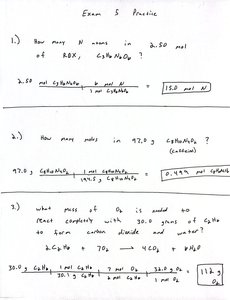
Q2. How many moles are in 97.0 g of C8H10N4O2 (caffeine)?
Background
Topic: Mass-to-mole conversion using molar mass
This question tests your ability to convert grams of a substance to moles using its molar mass.
Key Terms and Formulas
Molar Mass: The mass of one mole of a substance (in g/mol)
Formula:
Step-by-Step Guidance
Calculate the molar mass of caffeine () by adding the atomic masses of each element.
Set up the conversion: Divide the given mass (97.0 g) by the molar mass of caffeine.
Ensure your units cancel properly to give moles.
Try solving on your own before revealing the answer!
Q3. What mass of O2 is needed to react completely with 30.0 g of C6H12O6 to form carbon dioxide and water?
Background
Topic: Stoichiometry – mass-to-mass conversion in a chemical reaction
This question tests your ability to use a balanced chemical equation to determine the mass of a reactant needed for a reaction.
Key Terms and Formulas
Stoichiometry: Relating quantities of reactants and products using a balanced equation
Balanced Equation:
Mass-to-mole conversion:
Mole ratio: Use coefficients from the balanced equation
Step-by-Step Guidance
Calculate the moles of from the given mass using its molar mass.
Use the mole ratio from the balanced equation to find moles of needed.
Convert moles of to grams using the molar mass of $O_2$.
Try solving on your own before revealing the answer!
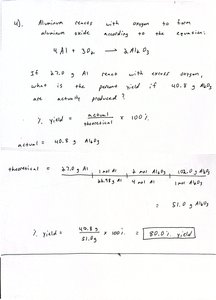
Q4. Aluminum reacts with oxygen to form aluminum oxide. If 27.0 g Al reacts with excess oxygen, what is the percent yield if 40.8 g Al2O3 are actually produced?
Background
Topic: Percent yield in chemical reactions
This question tests your ability to calculate percent yield based on actual and theoretical yields.
Key Terms and Formulas
Percent Yield:
Theoretical Yield: Maximum amount of product possible based on stoichiometry
Actual Yield: Amount of product actually obtained
Step-by-Step Guidance
Write the balanced equation:
Convert grams of Al to moles using its molar mass.
Use the mole ratio to find moles of produced.
Convert moles of to grams (theoretical yield).
Set up the percent yield formula using actual and theoretical yields.
Try solving on your own before revealing the answer!
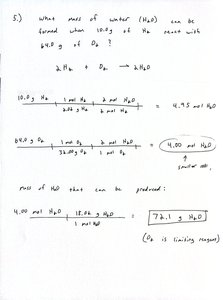
Q5. What mass of water (H2O) can be formed when 10.0 g of H2 reacts with 80.0 g of O2?
Background
Topic: Limiting reactant and mass-to-mass conversion
This question tests your ability to identify the limiting reactant and calculate the mass of product formed.
Key Terms and Formulas
Limiting Reactant: The reactant that is completely consumed first, limiting the amount of product formed
Balanced Equation:
Mass-to-mole conversion:
Mole ratio: Use coefficients from the balanced equation
Step-by-Step Guidance
Convert the mass of and to moles using their molar masses.
Use the balanced equation to determine which reactant is limiting.
Use the limiting reactant to calculate moles of produced.
Convert moles of to grams using its molar mass.
Try solving on your own before revealing the answer!