 Back
BackStudy Guidance: Lewis Structures and Gas Laws
Study Guide - Smart Notes
 Tailored notes based on your materials, expanded with key definitions, examples, and context.
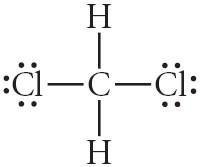
Q1. Which is the most complete Lewis structure for CH2Cl2?
Background
Topic: Lewis Structures and Molecular Geometry
This question tests your ability to draw and interpret Lewis structures for molecules, specifically dichloromethane (CH2Cl2), and to identify the most complete structure based on valence electrons and bonding.
Key Terms and Concepts:
Lewis Structure: A diagram showing the arrangement of atoms and valence electrons in a molecule.
Valence Electrons: Electrons in the outermost shell of an atom, involved in bonding.
Octet Rule: Atoms tend to form bonds until they have eight electrons in their valence shell (except hydrogen, which needs two).
Step-by-Step Guidance
Count the total number of valence electrons for CH2Cl2: Carbon (4), Hydrogen (1 each), Chlorine (7 each).
Arrange the atoms: Carbon is the central atom, with two hydrogens and two chlorines attached.
Draw single bonds between carbon and each hydrogen and chlorine. Each bond represents two electrons.
Distribute remaining electrons as lone pairs on the chlorine atoms to satisfy the octet rule.
Check that all atoms (except hydrogen) have a complete octet and that the total number of electrons matches your count.
Try solving on your own before revealing the answer!
Final Answer:
The most complete Lewis structure for CH2Cl2 is the one where carbon is bonded to two hydrogens and two chlorines, and each chlorine has three lone pairs of electrons.
This structure satisfies the octet rule for all atoms and correctly represents the valence electrons.
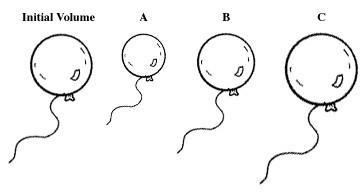
Q2. The balloon is put into a chamber whose pressure is less than the atmospheric pressure and at atmospheric temperature. Which diagram corresponds to this change?
Background
Topic: Gas Laws (Boyle's Law)
This question tests your understanding of how changes in pressure affect the volume of a gas, as described by Boyle's Law.
Key Terms and Formulas:
Boyle's Law:
Pressure (P): The force exerted by gas particles on the walls of a container.
Volume (V): The space occupied by the gas.
Step-by-Step Guidance
Recall that decreasing the pressure on a gas (while keeping temperature constant) causes the volume to increase.
Examine the diagrams: Look for the balloon that is larger than the initial volume, indicating increased volume due to decreased pressure.
Compare the sizes of the balloons labeled A, B, and C to determine which one best represents the effect of lower pressure.
Try solving on your own before revealing the answer!
Final Answer:
The diagram that corresponds to the balloon in a chamber with lower pressure is the one where the balloon is larger than its initial volume.
This demonstrates Boyle's Law: as pressure decreases, volume increases.
