 Back
Study Guide: Chemical Reactions – Energy, Rate, and Equilibrium
Study Guide - Smart Notes
 Tailored notes based on your materials, expanded with key definitions, examples, and context.
Ch.7 Chemical Reactions: Energy, Rate and Equilibrium
Nature of Energy
Energy is a fundamental concept in chemistry, representing the capacity to do work or produce heat. Thermochemistry studies the energy changes associated with chemical reactions and physical changes.
Energy: The ability to do work or produce heat.
SI Unit for Energy: Joule (J).
Classification of Energy:
Potential Energy: Energy due to position or arrangement of atoms.
Kinetic Energy: Energy due to motion of atoms.
Chemical Energy: Energy stored in chemical bonds.
Thermal Energy: Energy related to temperature and motion of atoms.
Energy Conversion Factors:
1 calorie (cal) = 4.184 J
1 Calorie (Cal) = 4184 J
1 kilowatt-hour (kWh) = 3.60 x 10⁶ J
First Law of Thermodynamics
The First Law states that energy cannot be created or destroyed, only transferred between a system and its surroundings.
System: The part of the universe being studied (e.g., a chemical reaction).
Surroundings: Everything outside the system.
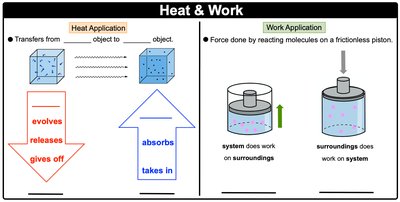
Heat (q): Transfer of thermal energy from a higher temperature object to a lower temperature object.
Work (w): Energy transfer due to movement against a force.
Endothermic & Exothermic Reactions
Chemical reactions can absorb or release energy, affecting the speed and nature of molecular changes.
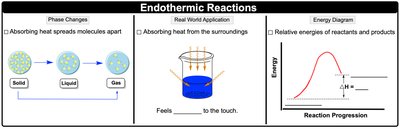
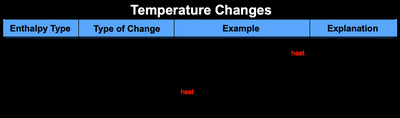
Endothermic Reactions: Absorb heat from surroundings; molecules speed up and may break bonds.
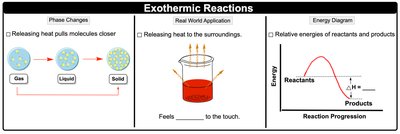
Exothermic Reactions: Release heat to surroundings; molecules slow down and may form bonds.
Bond Energy and Enthalpy of Reaction
Bond energy is the energy required to break a bond between atoms. It is used to calculate the enthalpy change (ΔH) of a reaction.
Bond Energy (ΔHB.E.): Energy stored in a bond.
Enthalpy of Reaction (ΔHRxn): Calculated using bond energies of reactants and products.
Endothermic Process: Energy is absorbed to break bonds (ΔH > 0).
Exothermic Process: Energy is released when bonds form (ΔH < 0).
Enthalpy of Reaction Formula:
Thermochemical Equations and Stoichiometry
Thermochemical equations include enthalpy changes and are used to relate quantities of reactants and products.
Convert given quantity to moles.
Use mole-to-mole comparison from balanced equation.
Convert moles of unknown to desired units (grams, molecules, etc.).
Compare theoretical yields if multiple products are calculated.
Spontaneous vs Nonspontaneous Reactions
Spontaneity determines whether a reaction occurs without continuous external energy.
Spontaneous: Occurs without constant outside energy; products form at equilibrium.
Nonspontaneous: Requires constant outside energy; does not form products at equilibrium.
Spontaneity does not determine reaction speed.
Entropy (S)
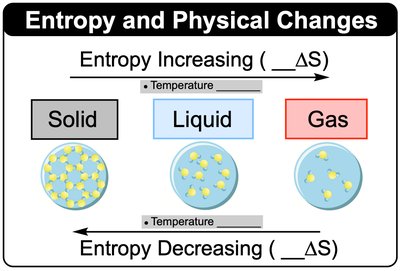
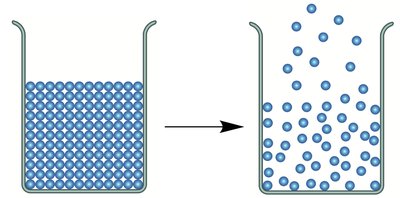
Entropy is a measure of disorder or randomness in a system. The Second Law of Thermodynamics states that the entropy of the universe always increases in spontaneous reactions.
Entropy Change (ΔS): Indicates increase or decrease in disorder.
Physical changes (solid → liquid → gas) generally increase entropy.
Chemical changes can increase or decrease entropy depending on bond formation and number of gas molecules.
Gibbs Free Energy (ΔG)
Gibbs Free Energy determines the spontaneity of a reaction. It combines enthalpy (ΔH), entropy (ΔS), and temperature (T).
ΔG Formula:
ΔG & Spontaneity:
ΔG < 0: Spontaneous
ΔG > 0: Nonspontaneous
ΔG = 0: Equilibrium
Sign of ΔH and ΔS can predict spontaneity at different temperatures.
Rate of Reaction
Chemical kinetics studies the rate at which reactants are converted to products.
Factors Affecting Rate:
Concentration: Higher concentration increases collision frequency.
Surface Area: Greater surface area increases collision frequency.
Temperature: Higher temperature increases collision energy and frequency.
Catalyst: Lowers activation energy, increasing reaction rate.
Energy Diagrams
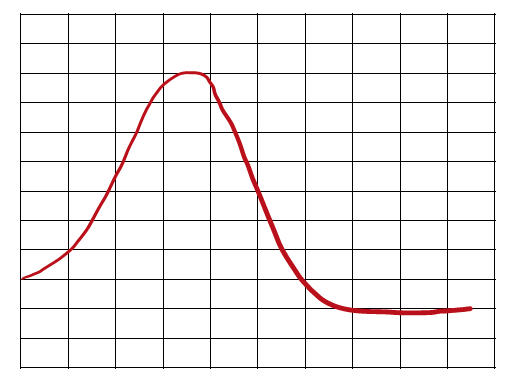
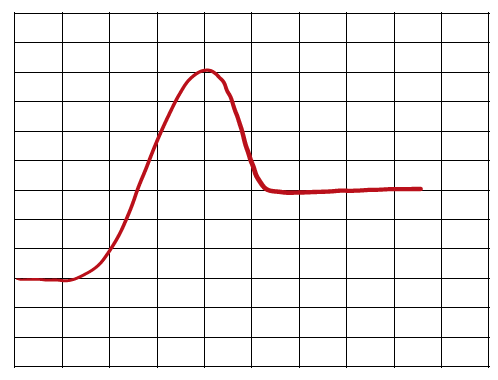
Energy diagrams illustrate the energy changes during a reaction, including reactants, products, transition state, and activation energy.
Reactants: Start of the diagram.
Products: End of the diagram.
Transition State: Highest energy point.
Activation Energy (Ea): Energy barrier for the reaction.
Overall Energy: Difference between reactants and products.
Rate Law
The rate law expresses the relationship between reaction rate, reactant concentrations, and reaction order.
Rate Law Expression:
k: Rate constant
m, n: Reaction orders (determined experimentally)
Rate law ignores products.
Chemical Equilibrium
Most reactions reach equilibrium, where the forward and reverse reactions occur at equal rates and concentrations remain constant.
Equilibrium: Reactant and product concentrations are constant, not necessarily equal.
Dynamic Process: Both forward and reverse reactions continue.
The Equilibrium Constant (K)
The equilibrium constant (K) is the ratio of product concentrations to reactant concentrations at equilibrium.
K > 1: Products favored.
K < 1: Reactants favored.
K excludes solids and pure liquids.
Equilibrium Expression:
Le Chatelier’s Principle
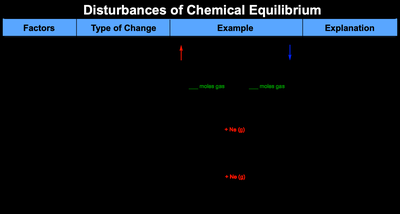
If a system at equilibrium is disturbed, it will shift to minimize the disturbance and re-establish equilibrium.
Disturbances: Changes in concentration, pressure, or temperature.
Catalysts: Do not shift equilibrium, only change rate.
Additional info: Academic context and explanations have been expanded for clarity and completeness. All included images directly reinforce the adjacent explanations and are strictly relevant to the topic.
