 Back
BackStudy Guide: chp 2
Study Guide - Smart Notes
 Tailored notes based on your materials, expanded with key definitions, examples, and context.
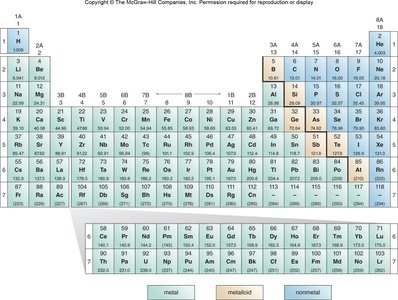
Q1. Locate each element in the periodic table and classify it as a metal, nonmetal, or metalloid. a. Titanium b. Chlorine
Background
Topic: Classification of Elements This question tests your understanding of how elements are organized in the periodic table and how to classify them as metals, nonmetals, or metalloids based on their position and properties.
Key Terms and Concepts:
Metal: Elements that are typically shiny, good conductors of heat and electricity, and are found on the left side of the periodic table.
Nonmetal: Elements that are usually dull, poor conductors, and are found on the right side of the periodic table.
Metalloid: Elements with properties intermediate between metals and nonmetals, found along the zigzag line starting at boron (B).
Step-by-Step Guidance
Find each element (Titanium and Chlorine) on the periodic table. Note their group and period.
Recall the general regions: metals (left and center), nonmetals (upper right), metalloids (stair-step line).
Check the properties of each element if needed (e.g., is it shiny, a good conductor, etc.).
Classify each element based on its position and properties.
Try solving on your own before revealing the answer!
Final Answer:
a. Titanium is a metal (transition metal, found in the center block). b. Chlorine is a nonmetal (found in group 7A, upper right).
We used the periodic table's layout and the properties of each region to classify the elements.
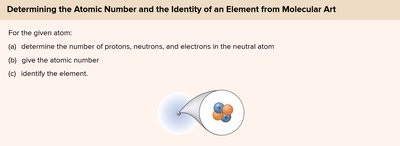
Q2. For the given atom: (a) determine the number of protons, neutrons, and electrons in the neutral atom; (b) give the atomic number; (c) identify the element.
Background
Topic: Atomic Structure This question tests your ability to interpret atomic diagrams and relate them to the atomic number, element identity, and subatomic particle counts.
Key Terms and Concepts:
Proton: Positively charged particle in the nucleus; number defines the element.
Neutron: Neutral particle in the nucleus; number can vary (isotopes).
Electron: Negatively charged particle in the electron cloud; equals protons in a neutral atom.
Atomic Number (Z): Number of protons in the nucleus.
Step-by-Step Guidance
Count the number of protons (red spheres with +) in the nucleus.
Count the number of neutrons (neutral spheres) in the nucleus.
Count the number of electrons (small blue spheres) in the electron cloud.
Assign the atomic number (equal to the number of protons).
Use the atomic number to identify the element on the periodic table.
Try solving on your own before revealing the answer!
Final Answer:
(a) The atom has 3 protons, 4 neutrons, and 3 electrons. (b) The atomic number is 3. (c) The element is lithium (Li).
We matched the atomic number to the periodic table to identify the element.
Q3. Identify the element that has an atomic number of 19, and give the number of protons and electrons in the neutral atom.
Background
Topic: Atomic Number and Element Identity This question tests your ability to use the atomic number to identify an element and determine its subatomic particle counts.
Key Terms and Concepts:
Atomic Number (Z): Number of protons in the nucleus; also equals the number of electrons in a neutral atom.

Step-by-Step Guidance
Locate atomic number 19 on the periodic table.
Read the element symbol and name for Z = 19.
Recall that in a neutral atom, the number of protons equals the number of electrons.
State the number of protons and electrons for this element.
Try solving on your own before revealing the answer!
Final Answer:
The element with atomic number 19 is potassium (K). It has 19 protons and 19 electrons in a neutral atom.
We used the periodic table to match the atomic number to the element.
Q4. How many protons, neutrons, and electrons are contained in each atom with the given atomic number and mass number? a. Z = 17, A = 35 b. Z = 14, A = 28
Background
Topic: Isotopes and Atomic Structure This question tests your ability to determine the number of subatomic particles in an atom using atomic number (Z) and mass number (A).
Key Terms and Formulas:
Atomic Number (Z): Number of protons.
Mass Number (A): Total number of protons and neutrons.
Number of Neutrons:
Number of Electrons: Equals protons in a neutral atom.

Step-by-Step Guidance
For each atom, write down the atomic number (Z) and mass number (A).
Number of protons = Z.
Number of neutrons = A - Z.
Number of electrons = Z (for a neutral atom).
Try solving on your own before revealing the answer!
Final Answer:
a. Z = 17, A = 35: 17 protons, 18 neutrons, 17 electrons. b. Z = 14, A = 28: 14 protons, 14 neutrons, 14 electrons.
We subtracted the atomic number from the mass number to find neutrons.
Q5. For each atom, give the following information: (1) the atomic number, (2) the mass number, (3) the number of protons, (4) the number of neutrons, (5) the number of electrons. a. 118Sn b. 195Pt
Background
Topic: Isotope Symbols and Subatomic Particles This question tests your ability to interpret isotope notation and extract information about atomic structure.
Key Terms and Formulas:
Isotope Symbol: , where A is the mass number.
Atomic Number (Z): Found on the periodic table for each element.
Number of Neutrons:
Number of Protons: Z
Number of Electrons: Z (for a neutral atom)
Step-by-Step Guidance
Identify the element (Sn for tin, Pt for platinum) and look up its atomic number (Z) on the periodic table.
Write down the mass number (A) from the isotope symbol.
Number of protons = Z.
Number of neutrons = A - Z.
Number of electrons = Z (for a neutral atom).
Try solving on your own before revealing the answer!
Final Answer:
a. 118Sn: Z = 50, A = 118, 50 protons, 68 neutrons, 50 electrons. b. 195Pt: Z = 78, A = 195, 78 protons, 117 neutrons, 78 electrons.
We used the periodic table to find atomic numbers and subtracted to find neutrons.
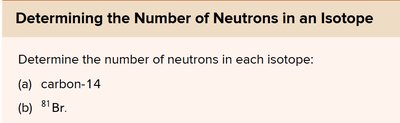
Q6. Determine the number of neutrons in each isotope: (a) carbon-14 (b) 81Br
Background
Topic: Isotopes and Neutron Calculation This question tests your ability to determine the number of neutrons in an isotope using its mass number and atomic number.
Key Terms and Formula:
Mass Number (A): Total number of protons and neutrons.
Atomic Number (Z): Number of protons (from periodic table).
Number of Neutrons:

Step-by-Step Guidance
For each isotope, write down the mass number (A).
Look up the atomic number (Z) for the element (C for carbon, Br for bromine).
Subtract Z from A to find the number of neutrons:
Try solving on your own before revealing the answer!
Final Answer:
(a) Carbon-14: 8 neutrons (A = 14, Z = 6). (b) 81Br: 46 neutrons (A = 81, Z = 35).
We subtracted the atomic number from the mass number for each isotope.
Q7. Calculate the atomic weight of each element given the mass and natural occurrence of each isotope. a. Magnesium-24, Magnesium-25, Magnesium-26 b. Vanadium-50, Vanadium-51
Background
Topic: Atomic Weight Calculation This question tests your ability to calculate the weighted average atomic mass of an element using isotope masses and abundances.
Key Formula:

Step-by-Step Guidance
Convert each isotopic abundance from percent to decimal (divide by 100).
Multiply each isotope's mass by its fractional abundance.
Add the products for all isotopes to get the atomic weight.
Try solving on your own before revealing the answer!
Final Answer:
a. Magnesium: Atomic weight ≈ 24.31 amu b. Vanadium: Atomic weight ≈ 50.94 amu
We used the weighted average formula with the given masses and abundances.
