 Back
Study Notes: Naming and Properties of Alcohols, Ethers, Thiols, and Chirality (Ch.14)
Study Guide - Smart Notes
 Tailored notes based on your materials, expanded with key definitions, examples, and context.
Ch.14 Some Compounds with Oxygen, Sulfur, or a Halogen
Naming Alcohols
Alcohols are organic compounds containing a hydroxyl (OH) group attached to an sp3 hybridized carbon. The systematic naming of alcohols follows rules similar to alkanes, with modifications to indicate the presence of the functional group.
Key Point 1: The parent chain must include the OH group and be the longest possible chain containing it.
Key Point 2: The suffix changes from -e (alkane) to -ol (alcohol).
Key Point 3: Number the chain from the end closest to the OH group; if tied, use the next closest substituent or alphabetical order.
Key Point 4: Assign numbers to substituents and the OH group location.
Key Point 5: Common names for simple alcohols use the alkyl group name followed by "alcohol." (Example: methyl alcohol, ethyl alcohol)
Example: The compound with a six-carbon chain, an OH group, and multiple chlorine substituents would be named by locating the OH group, numbering the chain, and listing substituents in alphabetical order.
Alcohol Classification
Alcohols are classified based on the number of alkyl groups attached to the carbon bearing the OH group:
Primary (1°) Alcohol: One alkyl group attached
Secondary (2°) Alcohol: Two alkyl groups attached
Tertiary (3°) Alcohol: Three alkyl groups attached
Example: Methanol is a primary alcohol; isopropanol is secondary; tert-butanol is tertiary.
Naming Ethers
Ethers are compounds with an oxygen atom connected to two alkyl groups. Their naming involves identifying both alkyl groups and ending the name with "ether." For IUPAC naming, the smaller alkyl group is treated as an alkoxy substituent.
Key Point 1: Name both alkyl groups alphabetically; if identical, use a numerical prefix (e.g., diethyl ether).
Key Point 2: For IUPAC, the larger group is the parent chain, and the smaller is named as an alkoxy substituent (e.g., methoxyethane).
Example: CH3CH2CH2OCH3 is called propyl methyl ether (common) or methoxypropane (IUPAC).
Naming Thiols
Thiols (mercaptans) are organic compounds containing a sulfhydryl (SH) group. Their naming is similar to alcohols, with the suffix -thiol added to the parent chain name.
Key Point 1: The parent chain must include the SH group and be the longest possible chain containing it.
Key Point 2: Number the chain from the end closest to the SH group.
Key Point 3: Assign numbers to substituents and the SH group location.
Example: 2-ethylcyclopentanethiol is a thiol with an ethyl group at position 2 of a cyclopentane ring and an SH group.
Properties of Alcohols
Boiling Point
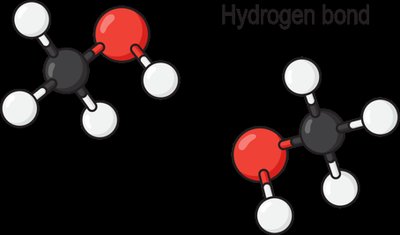
Alcohols have higher boiling points than hydrocarbons or ethers of similar molar mass due to hydrogen bonding between alcohol molecules, which makes them harder to separate.
Key Point 1: Hydrogen bonding increases boiling point.
Key Point 2: Longer carbon chains generally increase boiling point.
Example: 2-octanol has a higher boiling point than 2-butanol due to its longer chain.
Solubility
Alcohols are often water soluble due to their polar OH group, which allows hydrogen bonding with water. Solubility decreases as the number of carbon atoms increases.
≤ 3-C alcohols: Soluble
4-C alcohols: Slightly soluble
≥ 5-C alcohols: Insoluble
Example: Methanol is soluble in water, while 1-octanol is only slightly soluble.
Properties of Diols and Triols
Diols and triols (alcohols with two or three OH groups) have higher boiling points and are more soluble than monohydric alcohols due to increased hydrogen bonding and polarity.
Key Point 1: Multiple OH groups strengthen intermolecular forces.
Key Point 2: Increased polarity enhances solubility in water.
Example: Propane-1,2,3-triol (glycerol) is highly soluble in water.
Alcohol Reactions: Dehydration Reactions
Alcohols can undergo dehydration reactions in the presence of acid (e.g., H2SO4), forming alkenes by losing water. The reaction follows Zaitsev’s Rule, which states that the hydrogen is removed from the neighboring carbon with the fewest hydrogens.
Key Point 1: Dehydration forms a double bond (alkene).
Key Point 2: Zaitsev’s Rule guides which hydrogen is lost.
Example: Dehydration of 2-butanol forms 2-butene as the major product.
Intro to Redox Reactions
Redox reactions involve the transfer of electrons. In organic chemistry, oxidation increases the number of oxygen bonds, while reduction increases the number of hydrogen bonds.
Oxidation: Increase in C–O bonds
Reduction: Increase in C–H bonds
Example: Oxidation of an alcohol to a ketone or aldehyde.
Alcohol Reactions: Oxidation Reactions
Alcohols can be oxidized using agents like potassium dichromate (K2Cr2O7) in acid. Primary alcohols oxidize to aldehydes, then carboxylic acids; secondary alcohols to ketones; tertiary alcohols do not oxidize easily.
Key Point 1: Oxidizing agent adds oxygen bonds without breaking C–C bonds.
Key Point 2: Tertiary alcohols generally do not undergo oxidation.
Example: 1-propanol oxidizes to propanal, then to propanoic acid.
Reactions of Thiols
Thiols can be oxidized to form disulfides. Two thiol molecules lose hydrogen atoms and form an S–S bond. Reduction can convert disulfides back to thiols.
Key Point 1: Oxidation of thiols forms disulfides.
Key Point 2: Reduction reverses the process.
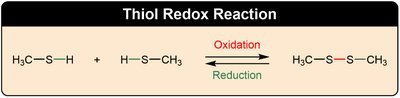
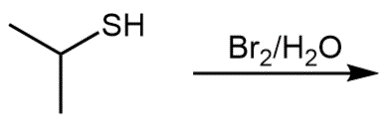
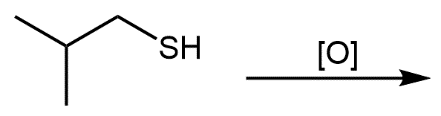
Example: Oxidation of two molecules of ethanethiol forms diethyl disulfide.
Chirality
Chirality is a property of molecules whose mirror images are not superimposable. Chiral molecules have at least one chiral center (a carbon attached to four unique groups) and can rotate plane-polarized light.
Key Point 1: Chiral centers are carbons with four different groups.
Key Point 2: Chiral molecules are optically active.
Key Point 3: Enantiomers are pairs of chiral molecules that are mirror images.

Example: 2-butanol is chiral; its enantiomers are non-superimposable mirror images.
Drawing Enantiomers: Enantiomers can be drawn by either reflecting the molecule in a mirror or by switching the wedge/dash notation at the chiral center.
