 Back
Terms, Units, and Dimensional Analysis in Chemistry
Study Guide - Smart Notes
 Tailored notes based on your materials, expanded with key definitions, examples, and context.
Terms, Units, and Dimensional Analysis in Chemistry
Introduction to Chemistry Measurements
Chemistry relies on precise measurements and the use of standardized units to describe quantities such as mass, volume, and amount of substance. Understanding how to convert between units and apply dimensional analysis is essential for solving chemical problems accurately.
Key Terms and Units in Chemistry
Measurement: A quantitative observation that includes both a number and a unit (e.g., 5.0 g, 250 mL).
SI Units: The International System of Units is the standard for scientific measurements. Common SI units in chemistry include the meter (m) for length, kilogram (kg) for mass, second (s) for time, and mole (mol) for amount of substance.
Conversion Factor: A ratio derived from the equality between two different units that can be used to convert from one unit to another (e.g., 1 kg = 1000 g, so the conversion factor is 1000 g / 1 kg).
Dimensional Analysis (Factor-Label Method)
Dimensional analysis is a systematic approach to problem-solving that uses conversion factors to move from one unit to another. It is especially useful in chemistry for converting measurements and solving stoichiometry problems.
Steps in Dimensional Analysis:
Identify the given quantity and its unit.
Determine the unit you want to convert to.
Set up conversion factors so that units cancel appropriately.
Multiply through to obtain the answer in the desired unit.
Example: Convert 2.5 kilograms to grams.
Given: 2.5 kg
Conversion factor: 1 kg = 1000 g
Calculation:
Practice Problem: Dimensional Analysis Application
Suppose you are given a problem: "How many grams are in 2.5 kilograms?" Using dimensional analysis, you would set up the conversion as shown above.
Using Tables for Unit Conversions
Tables are often used to organize conversion factors and track the cancellation of units in multi-step problems. For example, converting between metric units or between English and metric units.
Unit | Equivalent |
|---|---|
1 kilogram (kg) | 1000 grams (g) |
1 gram (g) | 1000 milligrams (mg) |
1 liter (L) | 1000 milliliters (mL) |
Example Table: Dimensional Analysis Steps
The following table illustrates how to organize a multi-step conversion:
Step | Quantity | Conversion Factor | Result |
|---|---|---|---|
1 | 2.5 kg | 1000 g / 1 kg | 2500 g |
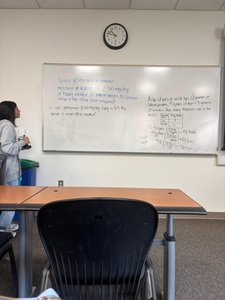
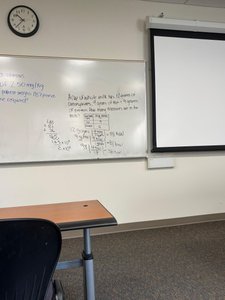
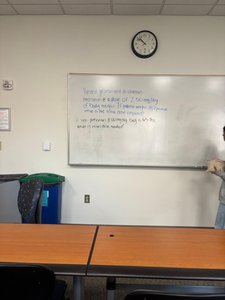
Additional info: The images reinforce the explanation of unit conversions and dimensional analysis, as they show worked examples and tables on the classroom whiteboard.
