 Back
BackThe Mole, Molar Mass, and Chemical Calculations in GOB Chemistry
Study Guide - Smart Notes
 Tailored notes based on your materials, expanded with key definitions, examples, and context.
The Mole and Avogadro’s Number
Counting Units in Chemistry
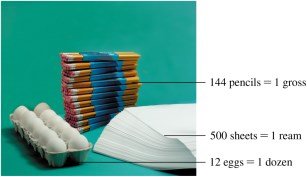
In chemistry, counting terms are used to specify a particular number of items, similar to how we use terms like dozen, gross, and ream in everyday life. The mole is the standard counting unit for atoms, molecules, and ions, allowing chemists to work with the extremely large numbers of particles involved in chemical reactions.
Counting Terms: 1 dozen = 12 items, 1 gross = 144 items, 1 ream = 500 sheets.
Mole (mol): The SI unit for amount of substance, defined as exactly 6.02 × 10²³ particles (Avogadro’s number).
Avogadro’s Number: particles per mole.
Avogadro’s Number and Its Application
Avogadro’s number is used to count extremely small particles such as atoms, molecules, and ions. It is named after Amedeo Avogadro, an Italian physicist.
1 mole of any element contains atoms of that element.
1 mole of a compound contains molecules or formula units of that compound.
Mole Calculations and Conversion Factors
Mole of Atoms and Molecules
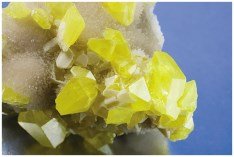
The mole allows chemists to convert between the mass of a substance and the number of particles it contains. For example, 1 mole of sulfur contains sulfur atoms.
Using Avogadro’s Number as a Conversion Factor
Avogadro’s number can be used to convert between moles and particles (atoms, molecules, ions):
Equality: particles
Conversion Factors:
Example: Converting Moles to Molecules
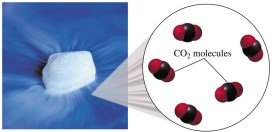
To find the number of CO2 molecules in 0.500 mole of CO2:
Calculation: molecules
Moles of Elements in Compounds
Subscripts and Mole Relationships
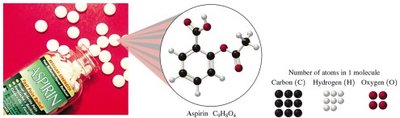
Subscripts in chemical formulas indicate the number of moles of each element in one mole of a compound. For example, in aspirin (C9H8O4):
1 mole of C9H8O4 contains 9 moles of C, 8 moles of H, and 4 moles of O.
Molar Mass and Its Calculation
Definition of Molar Mass
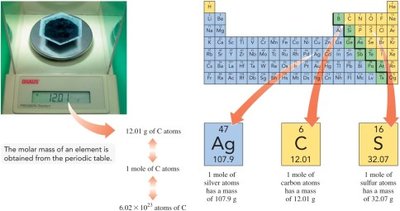
The molar mass of an element or compound is the mass in grams of one mole of that substance. For elements, the molar mass (in grams per mole) is numerically equal to the atomic mass (in atomic mass units, amu) found on the periodic table.
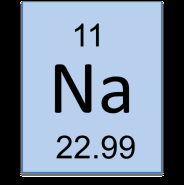
Example: 1 mole of sodium (Na) has a mass of 22.99 g.
Determining Molar Mass from the Periodic Table
The molar mass of a compound is calculated by summing the molar masses of its constituent elements, each multiplied by its subscript in the formula.
Example: For Li2CO3 (lithium carbonate):
2 × 6.941 g (Li) = 13.88 g
1 × 12.01 g (C) = 12.01 g
3 × 16.00 g (O) = 48.00 g
Total molar mass = 13.88 + 12.01 + 48.00 = 73.89 g/mol
Conversions Between Mass, Moles, and Particles
Using Molar Mass as a Conversion Factor
Molar mass is used to convert between grams and moles of a substance. For example, for methane (CH4):
1 mole CH4 = 16.05 g CH4
Conversion factors: and
Example: Converting Mass to Moles
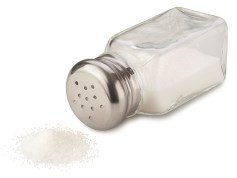
To find the number of moles in 737 g of NaCl:
Calculation:
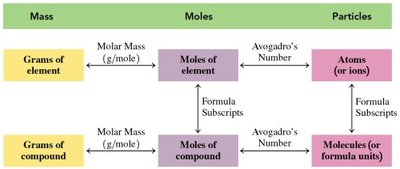
Map: Mass–Moles–Particles
The following diagram summarizes the relationships between mass, moles, and particles for elements and compounds:
Mole Relationships in Chemical Equations
Law of Conservation of Mass
In a chemical reaction, the total mass of reactants equals the total mass of products. This is known as the law of conservation of mass.
Matter cannot be created or destroyed in an ordinary chemical reaction.
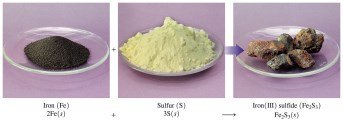
Mole–Mole Factors from Chemical Equations
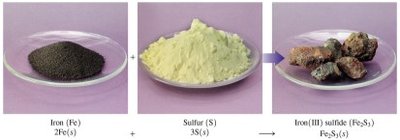
Balanced chemical equations provide the ratios (mole–mole factors) needed to convert between moles of reactants and products. For example, in the reaction:
2 Fe(s) + 3 S(s) → Fe2S3(s)
Mole ratios: 2 moles Fe : 3 moles S : 1 mole Fe2S3
Mass Calculations in Chemical Reactions
Stoichiometry: Mass–Mass Calculations
Stoichiometry involves using balanced chemical equations to calculate the masses of reactants and products. The process typically involves converting mass to moles, using mole ratios, and then converting back to mass if needed.
Example: Calculating the mass of acetylene used in welding or the mass of NH3 produced from a given mass of N2.

Limiting Reactants and Percent Yield
Limiting and Excess Reactants
In a chemical reaction, the limiting reactant is the substance that is completely consumed first, thus limiting the amount of product formed. The excess reactant is the substance that remains after the reaction is complete.
To identify the limiting reactant, calculate the amount of product formed from each reactant; the one that produces the least product is limiting.
Calculating Product from Limiting Reactant
When quantities of reactants are given in grams, the steps are:
Convert grams of each reactant to moles.
Use mole–mole factors to determine moles of product.
Convert moles of product to grams if needed.

Theoretical, Actual, and Percent Yield
Not all reactions go to completion. The theoretical yield is the maximum amount of product predicted by stoichiometry. The actual yield is the amount actually obtained. Percent yield is calculated as:
