 Back
BackWater, pH, and Reactions of Acids and Bases: Study Notes
Study Guide - Smart Notes
 Tailored notes based on your materials, expanded with key definitions, examples, and context.
Water, pH, and Reactions of Acids and Bases
Water as an Amphiprotic Substance
Water is a unique chemical compound that can act both as an acid and a base, making it the most common amphiprotic substance. Amphiprotic substances can donate or accept hydrogen ions (H+), depending on the reactant present. For example, water donates H+ when reacting with a strong base and accepts H+ when reacting with a strong acid. Bicarbonate (HCO3-) is another amphiprotic substance.
Acts as a base: Accepts H+ from acids.
Acts as an acid: Donates H+ to bases.
Behavior depends on the other reactant: Amphiprotic substances adjust their role based on the chemical environment.

Water Dissociation Expression (Kw)
The water dissociation expression describes the equilibrium between water molecules and their ions in aqueous solution. The equilibrium constant, Kw, is the product of the concentrations of hydronium ions ([H3O+]) and hydroxide ions ([OH-]). At 25°C, Kw is always:
Kw = [H3O+][OH-]
Kw = 1.0 \times 10^{-14} at 25°C
Knowing one ion concentration allows calculation of the other using Kw.
The pH Scale
The pH scale is a logarithmic scale used to describe the acidity or basicity of solutions, ranging from 0 to 14. It is based on the concentration of hydronium ions in solution:
Acidic solution: [H3O+] > [OH-], pH < 7.0
Neutral solution: [H3O+] = [OH-], pH = 7.0
Basic solution: [H3O+] < [OH-], pH > 7.0
Measuring pH
There are several methods to measure the pH of a solution:
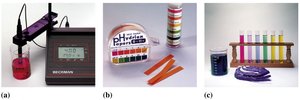
pH meters: Provide a digital display of pH values.
Indicator papers and solutions: Change color based on pH; colors are compared to a chart to determine pH.
Calculating pH of Solutions
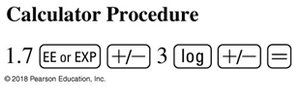
The pH scale is logarithmic, meaning each unit change represents a tenfold change in [H3O+]. The formulas for pH calculations are:
To calculate pH:
To calculate [H3O+]:
For example, a solution with pH 2 has ten times more [H3O+] than a solution with pH 3.
Neutralization Reactions
Neutralization reactions occur when an acid reacts with a base to produce water and a salt. The H+ from the acid combines with the OH- from the base to form H2O, and the salt is formed from the cation of the base and the anion of the acid.
General equation: Acid + Base → Water + Salt
Example:
Balancing: Coefficients may be needed to balance the number of H+ and OH- ions.
Example:
Buffers and Their Biological Importance
Buffers are solutions that resist changes in pH when small amounts of acid or base are added. They are crucial in biological systems, such as maintaining blood pH within the narrow range of 7.35–7.45.
Buffer composition: Typically a weak acid and its conjugate base (salt) in equal concentrations.
Mechanism: The acid neutralizes added base, and the base neutralizes added acid, preventing large pH changes.
Le Chatelier’s Principle: Buffers shift equilibrium to maintain pH.
Example:
When acid is added, equilibrium shifts to reactants; when base is added, equilibrium shifts to products, but [H3O+] and pH remain stable.
Summary Table: Acid-Base Properties and Buffer Action
Type | Definition | Example |
|---|---|---|
Acid | Donates H+ ions | HCl, HC2H3O2 |
Base | Accepts H+ ions | NaOH, C2H3O2- |
Buffer | Resists pH change | Acetic acid/sodium acetate |
Additional info: The notes above expand on brief lecture points to provide full academic context, including definitions, formulas, and examples. Images are included only where they directly clarify the explanation of amphiprotic behavior, pH measurement, and calculator procedure for pH calculation.
