 Back
Bone Development and Remodeling: From Embryo to Adulthood
Study Guide - Smart Notes
 Tailored notes based on your materials, expanded with key definitions, examples, and context.
Bone Development
Embryonic and Fetal Bone Formation
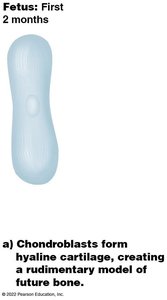
Bone development begins in the embryo and continues through adulthood, involving a series of cellular and molecular processes. The initial framework for bones is formed by chondroblasts, which produce hyaline cartilage. This cartilage model is gradually replaced by bone tissue through ossification.
Chondroblasts form hyaline cartilage, creating a rudimentary model of future bone.
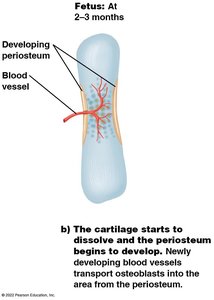
During the fetal stage (2–3 months), the periosteum and blood vessels develop, and cartilage begins to dissolve.
Blood vessels transport osteoblasts into the area, initiating ossification.
Ossification and Osteoblast Activity
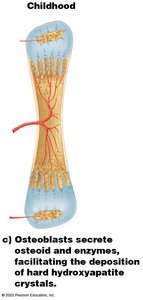
Ossification is the process by which cartilage is replaced by bone. Osteoblasts play a central role by secreting osteoid and enzymes that facilitate the deposition of hydroxyapatite, the mineral component of bone.
Osteoid: A mixture of proteins secreted by osteoblasts, forming the internal structure of bone.
Hydroxyapatite: The mineral that provides bone strength, produced with the help of osteoblast enzymes.
Osteoblasts eventually become embedded in the matrix, maturing into osteocytes that maintain bone tissue.
Bone Growth During Childhood and Adolescence
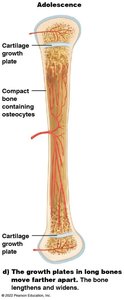
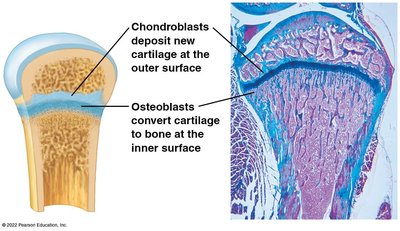
Bone growth is regulated by hormones and occurs at the epiphyseal (growth) plates. Chondroblasts continue to produce cartilage at the outer surface, while osteoblasts convert cartilage to bone at the inner surface, resulting in bone lengthening.
Epiphyseal plate: The site of active bone growth, where new cartilage is produced and converted to bone.
Growth hormone and sex hormones stimulate bone growth during childhood and adolescence.
As bone is deposited, the bone lengthens and the two epiphyseal plates move apart.
Bone Remodeling
Bone Remodeling Process
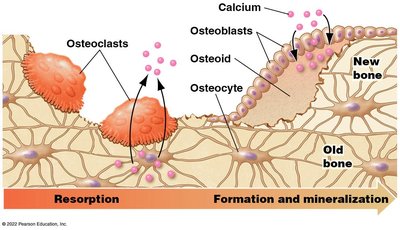
Bone remodeling is a continuous process involving the removal of mature bone (resorption) and the creation of new bone. This process is essential for maintaining bone strength and adapting to mechanical stress.
Osteoclasts: Specialized cells that break down bone tissue by secreting enzymes to dissolve hydroxyapatite and digest the osteoid matrix.
Calcium and phosphate ions are released into the blood during resorption.
New osteoblasts are attracted to the area, stimulating the deposition of new bone material.
Bone Remodeling and Mechanical Stress
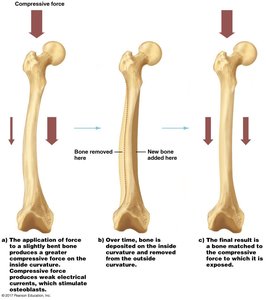
Bone adapts to mechanical stress by remodeling its structure. Areas exposed to high compressive force develop more bone, while bone is removed from areas of low stress. This adaptation ensures bones are strong where needed.
Weight-bearing exercises increase bone mass and strength.
Remodeled bone matches the distribution of compressive forces.
Bone Cells and Their Functions
Classification of Bone Cells
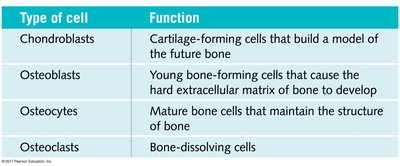
Bone tissue is maintained and remodeled by four main types of cells, each with distinct functions.
Type of cell | Function |
|---|---|
Chondroblasts | Cartilage-forming cells that build a model of the future bone |
Osteoblasts | Young bone-forming cells that cause the hard extracellular matrix of bone to develop |
Osteocytes | Mature bone cells that maintain the structure of bone |
Osteoclasts | Bone-dissolving cells |
Hormonal Regulation of Bone Growth
Calcitonin and Parathyroid Hormone
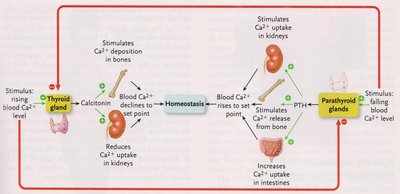
Bone growth and remodeling are regulated by hormones that maintain calcium homeostasis. Calcitonin and parathyroid hormone (PTH) act in opposition to control blood calcium levels and bone metabolism.
Calcitonin: Secreted by the thyroid gland when blood calcium levels are high. Stimulates osteoblast activity, inhibits osteoclasts, and promotes calcium deposition in bones.
Parathyroid Hormone (PTH): Secreted by the parathyroid glands when blood calcium levels are low. Stimulates osteoclast activity, increases calcium release from bones, and enhances calcium absorption in kidneys and intestines.
Imbalances can lead to bone demineralization and conditions such as osteoporosis.
Key Equations
Calcium homeostasis is maintained by the balance between bone deposition and resorption:
Deposition:
Resorption:
Summary
Bone development is a complex, regulated process that begins with cartilage formation and progresses through ossification, growth, and remodeling. Hormones play a critical role in maintaining bone health and calcium balance, while mechanical stress shapes bone structure throughout life.
