 Back
Bone Types and Structures: Long Bones and Cellular Organization
Study Guide - Smart Notes
 Tailored notes based on your materials, expanded with key definitions, examples, and context.
The Skeletal System
Long Bone Structure
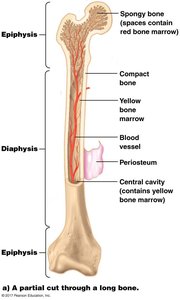
Long bones are a fundamental component of the human skeletal system, characterized by their elongated shape and specialized internal and external structures. Understanding the anatomy of a long bone is essential for comprehending its function in support, movement, and hematopoiesis.
Diaphysis: The cylindrical shaft of the bone, primarily composed of compact bone, provides strength and support.
Epiphysis: The rounded ends of the bone, containing spongy bone filled with red bone marrow and stem cells, crucial for blood cell production.
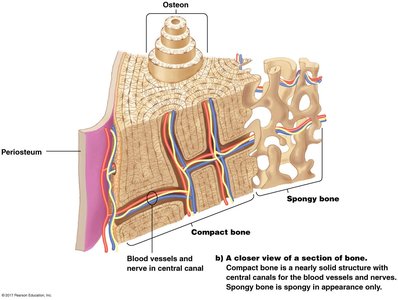
Compact Bone: Dense and solid, forms the outer layer of both diaphysis and epiphysis, offering protection and structural integrity.
Spongy Bone: Found within the epiphysis, contains spaces that house red bone marrow.
Periosteum: A tough connective tissue layer covering the bone's surface, involved in bone growth and repair.
Central Cavity: Located within the diaphysis, contains yellow bone marrow, which stores fat.
Blood Vessels: Supply nutrients and oxygen to bone tissue.
Cellular Organization of Bone: Osteocytes and Osteons
Bones are living tissues composed of specialized cells and organized structures that facilitate nutrient exchange and mechanical strength. The compact bone is organized into cylindrical units called osteons, which house osteocytes and enable efficient nutrient transport.
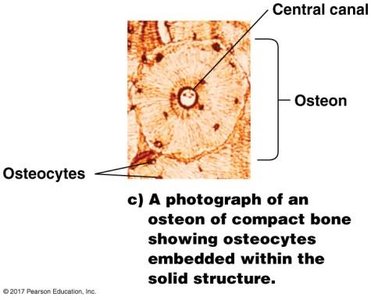
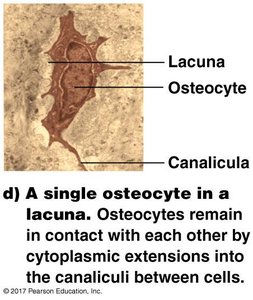
Osteocytes: Mature bone cells embedded within the bone matrix, responsible for maintaining bone tissue.
Osteons: Cylindrical structures in compact bone, consisting of concentric rings (lamellae) surrounding a central canal.
Haversian Canal (Central Canal): The central channel within each osteon, containing blood vessels and nerves.
Lacunae: Small cavities within the bone matrix where osteocytes reside.
Canaliculi: Tiny channels connecting lacunae, allowing osteocytes to exchange nutrients and waste via gap junctions.
Functions of Bone Structures
Each component of bone anatomy plays a distinct role in the overall function of the skeletal system:
Support and Protection: Compact bone provides rigidity and shields internal organs.
Movement: Long bones act as levers for muscle attachment and movement.
Hematopoiesis: Red bone marrow in the epiphysis produces blood cells.
Fat Storage: Yellow bone marrow in the diaphysis stores lipids.
Repair and Growth: Periosteum contains osteogenic cells for bone growth and healing.
Summary Table: Long Bone Structures and Functions
Structure | Location | Function |
|---|---|---|
Diaphysis | Shaft | Support, strength |
Epiphysis | Ends | Blood cell production, joint articulation |
Compact Bone | Outer layer | Protection, rigidity |
Spongy Bone | Epiphysis | Hematopoiesis |
Periosteum | Surface | Growth, repair |
Central Cavity | Diaphysis | Fat storage |
Osteon | Compact bone | Nutrient transport |
Lacunae | Bone matrix | House osteocytes |
Canaliculi | Between lacunae | Nutrient exchange |
Key Terms and Definitions
Osteocyte: A mature bone cell responsible for maintaining bone tissue.
Osteon: The structural unit of compact bone.
Lacuna: A small cavity in bone matrix housing an osteocyte.
Canaliculi: Microscopic channels connecting lacunae for cell communication.
Periosteum: The connective tissue covering bone surfaces.
Relevant Equations
While bone structure is primarily anatomical, the following formula relates to bone density:
Example: Application in Human Biology
Understanding the structure of long bones is essential for diagnosing bone diseases such as osteoporosis, which involves decreased bone density and increased fracture risk. The arrangement of osteocytes and osteons is critical for bone strength and repair.
