 Back
DNA Replication and Repair: Human Biology Study Notes
Study Guide - Smart Notes
 Tailored notes based on your materials, expanded with key definitions, examples, and context.
DNA Replication and Repair
Overview of DNA Functions
DNA is the fundamental molecule that carries genetic instructions for life. Its functions are essential for cell division, gene expression, and protein synthesis. The three main processes involving DNA are:
Replication: The process of making a copy of DNA prior to cell division, ensuring each new cell receives an identical set of genetic material.
Transcription: Producing a working copy (RNA) of a single gene that can leave the nucleus for protein synthesis.
Translation: The production of proteins as directed by the genetic code in RNA.
Replication is the focus of this section, with transcription and translation covered separately.
DNA Replication: Key Concepts
DNA replication is a highly regulated process that ensures genetic continuity during cell division. It occurs during the S-phase of Interphase and is described as semi-conservative, meaning each new DNA molecule contains one original strand and one newly synthesized strand.
Template Mechanism: The original DNA acts as a template for the formation of new strands.
Cell Division: Both daughter cells receive identical DNA after mitosis.
Timing: Replication occurs before cell division, taking approximately 7–8 hours.
Step 1: DNA Unwinds
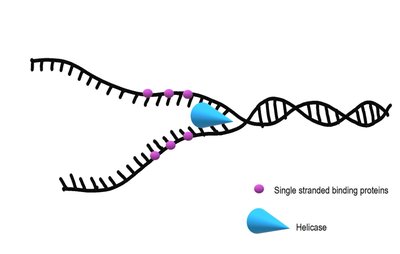
The first step in replication involves unwinding the DNA double helix. The enzyme helicase breaks the weak hydrogen bonds between nucleotide pairs, separating the two strands. Single stranded binding proteins stabilize the separated strands and prevent them from re-forming the helix.
Helicase: Unzips DNA at multiple locations.
Single stranded binding proteins: Prevent re-annealing of DNA strands.
Step 2: Formation of Replication Bubbles
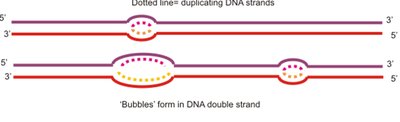
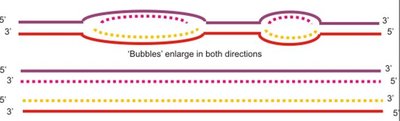
Replication does not occur along the entire DNA molecule at once. Instead, multiple helicase enzymes create several replication bubbles simultaneously, allowing for efficient duplication of large DNA molecules.
Replication bubbles: Regions where DNA strands are separated and replication occurs.
Multiple origins: Replication begins at several points along the DNA.
Step 3: Complimentary Pairing and Synthesis
New DNA strands are synthesized by pairing complementary nucleotides to the template strands. This process involves several enzymes:
Primase: Inserts an RNA primer to mark the starting point for DNA synthesis.
DNA Polymerase: Binds at the primer and adds new nucleotides, matching A with T and C with G.
Directionality: DNA is synthesized in the 5' to 3' direction.
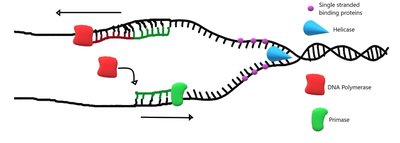
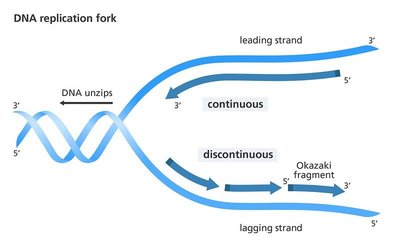
Replication proceeds until the entire strand is completed. The leading strand is synthesized continuously, while the lagging strand is synthesized in short segments called Okazaki fragments.
Leading strand: Synthesized continuously in the direction of helicase movement (3' to 5').
Lagging strand: Synthesized discontinuously in the opposite direction (5' to 3'), forming Okazaki fragments.
Step 4: Finishing and Ligase Activity
To complete DNA replication, the enzyme ligase repairs the sugar-phosphate backbone and connects gaps between Okazaki fragments on the lagging strand. The DNA strands then recoil into their double helix structure.
Ligase: Seals nicks in the backbone and joins Okazaki fragments.
Completion: Two identical daughter DNA molecules are formed, each with one original and one new strand.
Mutations and DNA Repair
Replication of billions of base pairs can result in errors or mutations. Mutations may be caused by biological, chemical, or physical factors and can affect cell function or be passed to new cells. Not all mutations are harmful; some contribute to genetic diversity.
Biological exposures: Viruses such as HPV.
Chemical substances: Pesticides, household chemicals.
Physical substances: Radiation, heat.
Mutation Checking and Repair
Cells have specialized enzymes to detect and repair mutations during the G2 phase:
"READ" enzymes: Recognize mismatched base pairs.
"CUT" enzymes: Remove incorrect nucleotides.
"REPLACE" enzymes: Insert correct nucleotides.
Efficiency: Repair mechanisms are most active between replication and mitosis.
Summary Table: Enzymes in DNA Replication
Enzyme | Function |
|---|---|
Helicase | Unwinds and separates DNA strands |
Single stranded binding proteins | Stabilize separated strands |
Primase | Adds RNA primer for initiation |
DNA Polymerase | Adds complementary nucleotides |
Ligase | Joins Okazaki fragments and repairs backbone |
Key Equations and Concepts
Base Pairing Rule: ,
Semi-conservative Replication: Each new DNA molecule contains one original strand and one new strand.
Example: DNA Replication in Human Cells
During the S-phase, a human cell replicates approximately 3 billion base pairs of DNA, resulting in two identical daughter strands. The process is highly accurate, but errors can occur and are corrected by repair enzymes.
Additional info: DNA replication is fundamental to cell reproduction and genetic inheritance, and errors in replication can lead to diseases such as cancer if not properly repaired.
