 Back
BackIntroduction to the Immune System: Principles and Mechanisms
Study Guide - Smart Notes
 Tailored notes based on your materials, expanded with key definitions, examples, and context.
Introduction to the Immune System
Overview of Immune System Function
The immune system is a complex network of cells, tissues, and organs that protects the body from harmful invaders while maintaining tolerance to self-components. It must distinguish between self and non-self, and further differentiate between harmless and harmful non-self substances.
Self-tolerance: The immune system does not attack the body's own proteins, cells, tissues, or organs.
Recognition of non-self: The immune system selectively identifies and responds to foreign molecules such as microbial proteins and carbohydrates.
Discrimination of threat: The immune system ignores harmless non-self substances but mounts a response against harmful or dangerous non-self entities.
Classes of Pathogens and Immune Protection
Types of Pathogens
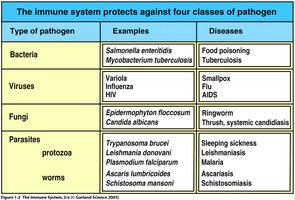
The immune system protects against four major classes of pathogens, each associated with specific diseases and examples.
Type of Pathogen | Examples | Diseases |
|---|---|---|
Bacteria | Salmonella enteritidis, Mycobacterium tuberculosis | Food poisoning, Tuberculosis |
Viruses | Variola, Influenza, HIV | Smallpox, Flu, AIDS |
Fungi | Epidermophyton floccosum, Candida albicans | Ringworm, Thrush, Systemic candidiasis |
Parasites (Protozoa) | Trypanosoma brucei, Leishmania donovani, Plasmodium falciparum | Sleeping sickness, Leishmaniasis, Malaria |
Parasites (Worms) | Ascaris lumbricoides, Schistosoma mansoni | Ascariasis, Schistosomiasis |
Example: Mycobacterium tuberculosis is a bacterial pathogen that causes tuberculosis, a serious respiratory disease.
Barriers to Infection and Routes of Pathogen Entry
Physical and Anatomical Barriers
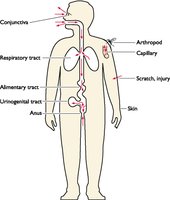
Pathogens must overcome several physical and anatomical barriers to establish infection in the human body. These barriers are the first line of defense and include the skin, mucous membranes, and various epithelial surfaces.
Skin: Acts as a physical barrier to most pathogens.
Mucosal surfaces: Line the respiratory, alimentary, and urogenital tracts, providing additional protection.
Other entry points: Conjunctiva, capillaries (via arthropod vectors), and sites of injury.
Example: Influenza virus typically enters the body through the respiratory tract, while Plasmodium falciparum (malaria) is introduced via mosquito bites into the bloodstream.
Sequence of Immune Response
Stages of Host Defense
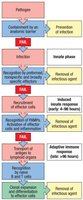
The immune response to infection occurs in a sequential manner, involving both innate and adaptive mechanisms. Each stage aims to prevent, control, or eliminate the pathogen.
Prevention of infection: Physical and chemical barriers block pathogen entry.
Innate immune response: Rapid, non-specific response involving phagocytes and inflammatory mediators.
Induced innate response: Recruitment and activation of additional immune cells if the pathogen persists.
Adaptive immune response: Specific recognition and elimination of pathogens by B and T lymphocytes.
Resolution: Clearance of infection and restoration of tissue homeostasis.
Example: If a pathogen breaches the skin, innate immune cells such as macrophages respond first, followed by activation of adaptive immunity if the infection is not cleared.
Relationship Between Innate and Adaptive Immunity
Components and Interactions
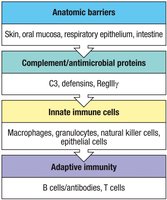
The immune system is organized into layers of defense, with innate immunity providing immediate, non-specific protection and adaptive immunity offering delayed but highly specific responses. These systems interact closely to ensure effective defense against pathogens.
Anatomic barriers: Skin, mucosa, and epithelial linings prevent pathogen entry.
Complement and antimicrobial proteins: Molecules such as C3, defensins, and RegIII directly attack pathogens or mark them for destruction.
Innate immune cells: Macrophages, granulocytes, natural killer cells, and epithelial cells recognize and respond to common pathogen features.
Adaptive immunity: B cells produce antibodies, and T cells mediate cellular immunity, both providing long-lasting and specific protection.
Example: The complement system can opsonize bacteria, making them easier targets for phagocytes, while adaptive immunity generates memory cells for faster response upon re-exposure.
Additional info: The coordination between innate and adaptive immunity is essential for both immediate and long-term protection against a wide variety of pathogens.
