 Back
Metabolic Pathways and Cellular Respiration: Glycolysis and the Preparatory Step
Study Guide - Smart Notes
 Tailored notes based on your materials, expanded with key definitions, examples, and context.
Metabolic Pathways and Energy Production
Introduction to Metabolism
Metabolism encompasses all chemical reactions occurring within an organism, enabling the maintenance of life. These reactions are organized into metabolic pathways, which are sequences of enzymatically catalyzed reactions where the product of one reaction serves as the substrate for the next.
Metabolic Pathways: Can be linear (sequential steps) or cyclic (repeating cycles).
Anabolic Pathways: Build larger molecules from smaller ones, requiring energy input (e.g., protein synthesis).
Catabolic Pathways: Break down molecules into smaller units, releasing energy (e.g., glucose breakdown).
Enzymes and Co-enzymes in Metabolism
Enzymes are biological catalysts essential for metabolic reactions. They lower activation energy and are not consumed in the reaction. Co-enzymes are non-protein molecules that assist enzymes, often by transferring electrons or functional groups.
NAD+ (Nicotinamide adenine dinucleotide): Accepts electrons and hydrogen ions, becoming NADH.
FAD (Flavin adenine dinucleotide): Another important electron carrier in metabolism.
ATP: The Energy Currency of the Cell
ATP Structure and Function
ATP (Adenosine triphosphate) stores energy in its high-energy phosphate bonds. Hydrolysis of ATP releases energy for cellular work:
Energy is released when the terminal phosphate bond is broken.
The reaction is reversible; ATP can be regenerated by phosphorylation of ADP.
Sources of Cellular Fuel
Cells primarily use glucose to generate ATP, but can also metabolize fats and proteins when glucose is scarce. Glycogen serves as a storage form of glucose in animals.
Overview of Cellular Respiration
Stages of Cellular Respiration
Cellular respiration is the process by which cells extract energy from glucose in the presence of oxygen, producing ATP, water, and carbon dioxide. It consists of four main stages:
Glycolysis (cytoplasm)
Preparatory Step (mitochondria)
Citric Acid Cycle (mitochondria)
Electron Transport System (mitochondria)
ATP is produced at three of these four stages.
Stage #1: Glycolysis
Process and Steps
Glycolysis is the anaerobic breakdown of glucose (6 carbons) into two molecules of pyruvate (3 carbons each), occurring in the cytoplasm. It consists of two phases:
Energy Investment Phase: 2 ATP are used to phosphorylate glucose, forming two G3P (glyceraldehyde-3-phosphate) molecules.
Energy Yielding Phase: Each G3P is converted to pyruvate, producing 4 ATP (net gain: 2 ATP) and 2 NADH by substrate-level phosphorylation.
Key points:
2 ATP invested, 4 ATP produced (net gain: 2 ATP).
2 NADH produced (electron carriers for later stages).
2 pyruvate molecules proceed to the next stage.
Stage #2: Preparatory Step
Conversion of Pyruvate to Acetyl CoA
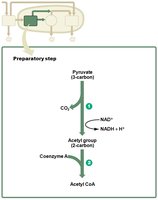
In the presence of oxygen, pyruvate enters the mitochondria and undergoes the preparatory step, linking glycolysis to the citric acid cycle. Each pyruvate (3 carbons) is converted into an acetyl group (2 carbons), releasing one molecule of CO2 and generating NADH. The acetyl group is then attached to coenzyme A, forming acetyl CoA.
No ATP is produced in this step.
2 NADH are generated (one per pyruvate).
2 molecules of CO2 are released as waste.
2 acetyl CoA molecules proceed to the citric acid cycle.
Summary Table: Glycolysis and Preparatory Step
Stage | Main Reactants | Main Products | ATP Produced | NADH Produced | Other Products |
|---|---|---|---|---|---|
Glycolysis | Glucose, 2 ATP, 2 NAD+ | 2 Pyruvate | 2 (net) | 2 | None |
Preparatory Step | 2 Pyruvate, 2 NAD+, 2 CoA | 2 Acetyl CoA | 0 | 2 | 2 CO2 |
Key Terms and Definitions
Metabolism: The sum of all chemical reactions in an organism.
Anabolism: Synthesis of complex molecules from simpler ones (requires energy).
Catabolism: Breakdown of complex molecules into simpler ones (releases energy).
Enzyme: Protein catalyst that speeds up chemical reactions.
Co-enzyme: Non-protein molecule that assists enzymes (e.g., NAD+, FAD).
ATP: Main energy currency of the cell.
Glycolysis: Anaerobic breakdown of glucose to pyruvate.
Pyruvate: 3-carbon end product of glycolysis.
Acetyl CoA: 2-carbon molecule entering the citric acid cycle.
Additional info: The subsequent stages of cellular respiration (citric acid cycle and electron transport chain) further process acetyl CoA and NADH to maximize ATP yield, but are not covered in this section.
