 Back
Pathology of the Skeletal System: Osteoporosis and Bone Injuries
Study Guide - Smart Notes
 Tailored notes based on your materials, expanded with key definitions, examples, and context.
Pathology of the Skeletal System
Overview of Skeletal System Injuries & Diseases
The skeletal system is susceptible to a variety of diseases and injuries that can significantly impact human health and mobility. This section focuses on common pathological conditions affecting bones and joints, including osteoporosis, bone fractures, sprains, carpal tunnel syndrome, bursitis, tendinitis, and arthritis.
Osteoporosis
Bone Breaks (Fractures)
Sprains
Carpal Tunnel Syndrome
Bursitis
Tendinitis
Arthritis
Osteoporosis
Definition, Causes, and Symptoms
Osteoporosis is a common condition characterized by a significant loss of bone mass, resulting in fragile and brittle bones. It primarily affects older women due to the natural decline in estrogen levels after menopause, which disrupts the balance between bone resorption and formation.
Symptoms:
Brittle bones
Hunched posture
Difficulty in walking
Increased risk of fractures, especially in hips and spine
Pathophysiology: Osteoporosis results from an imbalance over many years between the activity of osteoclasts (cells that break down bone) and osteoblasts (cells that build bone).
Example: A postmenopausal woman experiencing frequent hip fractures may be diagnosed with osteoporosis due to decreased estrogen levels.
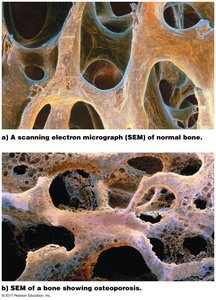
Prevention and Treatment
Preventing and treating osteoporosis involves lifestyle modifications and medical interventions aimed at maintaining bone density and reducing fracture risk.
Prevention:
Ensure adequate intake of calcium (1,000–1,500 mg/day) and vitamin D
Engage in regular weight-bearing exercise (e.g., walking, lifting weights)
Treatment:
Hormone replacement therapy (estrogen and calcitonin)
Medications that inhibit osteoclast activity (e.g., bisphosphonates)
Teriparatide: a fragment of parathyroid hormone (PTH) that stimulates osteoblast activity and increases bone density
Additional info: Osteoporosis is diagnosed using bone mineral density tests, such as dual-energy X-ray absorptiometry (DEXA).
Bone Fractures (Breaks)
Types of Bone Fractures
Bone fractures are classified based on the extent of damage to the bone and surrounding tissues. Understanding the types of fractures is essential for proper treatment and recovery.
Simple Fracture: The bone ends do not cause significant damage to surrounding tissues.
Complete Fracture: The bone separates into two pieces, often damaging soft tissue.
Compound Fracture: Broken bone ends or shards puncture the skin, increasing the risk of infection.
Example: A compound fracture of the tibia may require surgical intervention due to the risk of infection and extensive tissue damage.
Repair of Broken Bones
The repair process for broken bones involves several stages, beginning with bleeding and inflammation, followed by cellular migration and tissue regeneration.
Hematoma Formation: Bleeding at the fracture site forms a hematoma.
Inflammation: Swelling and pain occur in the days following the injury.
Callus Formation: Fibroblasts migrate to the area and differentiate into chondroblasts, producing a callus (a hard, raised ring) between the broken bone ends.
Bone Remodeling: Osteoclasts remove dead bone fragments and blood cells, while osteoblasts promote crystallization of calcium phosphate minerals, restoring bone integrity.
Additional info: Immobilization (e.g., casting) is essential to allow proper healing and "re-knitting" of the bone.
Summary Table: Osteoporosis vs. Bone Fractures
Condition | Causes | Symptoms | Treatment |
|---|---|---|---|
Osteoporosis | Imbalance between osteoclast and osteoblast activity; estrogen decline | Brittle bones, hunched posture, frequent fractures | Calcium/Vitamin D, exercise, hormone therapy, medications |
Bone Fractures | Trauma, falls, osteoporosis | Pain, swelling, deformity, hematoma | Immobilization, surgical repair, bone remodeling |
Key Terms
Osteoclasts: Cells that break down bone tissue.
Osteoblasts: Cells that build new bone tissue.
Hematoma: A localized collection of blood outside blood vessels, usually in tissue.
Callus: A hard, raised area formed during bone healing.
Relevant Equations
Bone mineral density is often measured and compared using statistical formulas:
Additional info: BMD stands for Bone Mineral Density, a key indicator in osteoporosis diagnosis.
