 Back
Protein Synthesis: Transcription, Translation, and Protein Structure
Study Guide - Smart Notes
 Tailored notes based on your materials, expanded with key definitions, examples, and context.
Protein Synthesis
Overview of Protein Synthesis
Protein synthesis is the process by which cells generate proteins, essential molecules for cellular structure and function. This process involves two main steps: transcription and translation. Transcription occurs in the nucleus, while translation takes place in the cytoplasm.
Transcription: DNA is used as a template to produce messenger RNA (mRNA).
Translation: mRNA is decoded to assemble amino acids into a polypeptide chain, forming a protein.
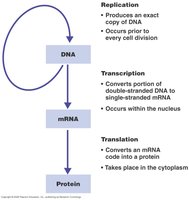
Interactions Between DNA & RNA
DNA contains the genetic instructions for life, while RNA acts as the messenger, carrying the code for protein synthesis.
DNA: Stores genetic information and instructions for producing RNA.
RNA: Transmits the genetic code from DNA to the cytoplasm for protein production.
Proteins: Execute most cellular functions and processes.
Genes
Genes are specific segments of DNA that code for proteins.
Gene: The smallest functional unit of DNA, coding for one or more proteins.
Humans have approximately 20,000 genes distributed across 46 chromosomes.
Gene expression occurs when a gene is activated and its protein product is synthesized.
Step 1: Transcription
Transcription Process
Transcription is the process of copying a gene from DNA into a complementary RNA strand.
A segment of DNA unwinds, exposing the template strand.
RNA polymerase enzyme synthesizes a single-stranded RNA by pairing complementary nucleotides.
The resulting RNA is called the RNA primary transcript.
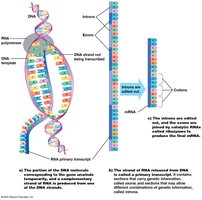
RNA Editing: Introns and Exons
The RNA primary transcript undergoes editing before becoming functional mRNA.
Introns: Non-coding regions removed by ribozymes.
Exons: Coding regions joined together to form mature mRNA.
Alternative splicing of exons can produce different mRNA variants.
Messenger RNA (mRNA)
mRNA exits the nucleus and carries the genetic message to ribosomes in the cytoplasm.
mRNA sequence is organized into codons, groups of three bases.
Each codon specifies one of the 20 amino acids required for protein synthesis.
There are 64 possible codons; some code for the same amino acid.
Other Key Players in Protein Synthesis
Ribosomal RNA (rRNA)
Forms ribosomal subunits in the nucleolus, which move to the cytoplasm.
Provides binding sites for mRNA and tRNA.
Contains enzymes for linking amino acids.
Transfer RNA (tRNA)
Carries an anticodon complementary to the mRNA codon.
Captures and delivers the correct amino acid to the ribosome.
Step 2: Translation
Translation Process
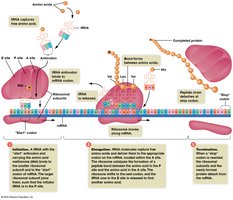
Translation is the decoding of mRNA into a polypeptide chain, which folds into a functional protein. The process occurs in three stages:
Initiation: Ribosome assembles around the mRNA, and the first tRNA binds to the start codon (AUG).
Elongation: tRNA brings amino acids to the ribosome, and peptide bonds form between them, lengthening the polypeptide chain.
Termination: When a stop codon is reached, the ribosome releases the completed polypeptide.
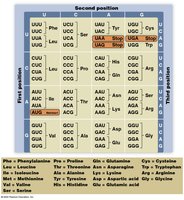
Codon Translation Table
The codon translation table is used to determine which amino acid corresponds to each mRNA codon.
Each codon (three-base sequence) codes for a specific amino acid.
Start codon: AUG (Methionine)
Stop codons: UAA, UAG, UGA (signal termination of translation)
Protein Structure
Levels of Protein Structure
The function of a protein depends on its structure, which is organized into four levels:
Primary Structure: The specific sequence of amino acids held together by peptide bonds. One change can cause diseases (e.g., sickle cell anemia).
Secondary Structure: The spatial orientation of the chain, including alpha-helix (spiral stabilized by hydrogen bonds) and beta-sheet (side-by-side sequences joined by hydrogen bonds).
Tertiary Structure: The three-dimensional folding of the protein, determined by amino acid interactions, disulfide bonds, and polarity.
Quaternary Structure: Association of multiple polypeptide chains to form a functional protein.
Examples and Applications
Sickle Cell Anemia: Caused by a single amino acid change in the primary structure of hemoglobin.
Enzymes: Proteins with specific tertiary and quaternary structures that catalyze biochemical reactions.
Key Terms and Definitions
Transcription: Synthesis of RNA from a DNA template.
Translation: Assembly of a protein from mRNA instructions.
Codon: Three-base sequence on mRNA coding for an amino acid.
Anticodon: Three-base sequence on tRNA complementary to mRNA codon.
Polypeptide: Long chain of amino acids forming a protein.
Relevant Equations
Peptide Bond Formation:
Central Dogma:
Summary Table: Players in Protein Synthesis
Component | Function |
|---|---|
DNA | Stores genetic information |
mRNA | Transmits genetic code to ribosome |
rRNA | Forms ribosome, catalyzes peptide bond formation |
tRNA | Delivers amino acids to ribosome |
Additional info:
Alternative splicing of exons allows for protein diversity.
Protein folding is assisted by chaperone proteins in the cell.
