 Back
Regulation and Disorders of the Cardiovascular System
Study Guide - Smart Notes
 Tailored notes based on your materials, expanded with key definitions, examples, and context.
Cardiovascular System Regulation
Maintaining Arterial Blood Pressure
The cardiovascular system ensures that every cell receives adequate blood flow to meet its metabolic needs. A constant arterial blood pressure is maintained by regulating cardiac output and the diameter of arterioles, which together control resistance to blood flow.
Cardiac Output: The volume of blood pumped by the heart into the aorta each minute. It is a key determinant of arterial blood pressure.
Arteriolar Diameter: Adjusting the diameter of arterioles changes vascular resistance, thereby influencing blood flow and pressure.
Baroreceptor Regulation and Negative Feedback
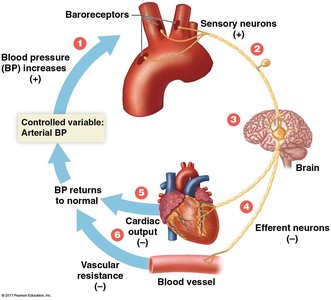
Baroreceptors are specialized sensory receptors located in the walls of certain arteries. They detect changes in blood pressure and initiate a negative feedback loop to restore normal levels.
1. Increased blood pressure stretches baroreceptors.
2. Sensory neurons innervating baroreceptors fire when stretched.
3. Signals are sent to the cardiovascular center in the brain.
4. The brain responds by adjusting nerve stimulation to the heart and blood vessels.
5. Heart rate and force of contraction decrease, lowering cardiac output.
6. Blood vessels reduce vascular resistance, increasing blood flow and returning blood pressure to normal.
Local Regulation of Blood Flow
Precapillary Sphincters and Metabolic Activity
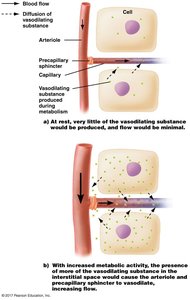
Blood flow to tissues is regulated locally by precapillary sphincters, which respond to metabolic needs. Increased metabolism leads to greater consumption of oxygen and nutrients, and increased production of waste products such as CO2.
At rest, minimal vasodilating substances are produced, resulting in low blood flow.
During increased metabolic activity (e.g., muscle contraction), vasodilating substances accumulate, causing arterioles and precapillary sphincters to dilate and increase blood flow.
Exercise and Cardiac Output
Effects of Exercise on the Cardiovascular System
Exercise increases metabolic activity, leading to a drop in local oxygen concentration and dilation of blood vessels supplying skeletal muscles. This triggers a baroreceptor-mediated reflex to increase cardiac output.
Sensory input from moving muscles and joints signals the cardiovascular center to stimulate the heart, increasing cardiac output before blood pressure changes significantly.
Target Heart Rate Zones
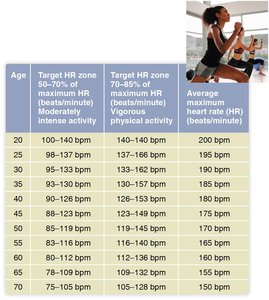
Target heart rate zones are used to guide exercise intensity. They are calculated as percentages of maximum heart rate, which decreases with age.
Age | Target HR zone (50–70%) Moderate activity | Target HR zone (70–85%) Vigorous activity | Average max HR |
|---|---|---|---|
20 | 100–140 bpm | 140–170 bpm | 200 bpm |
25 | 98–137 bpm | 137–166 bpm | 195 bpm |
30 | 95–133 bpm | 133–162 bpm | 190 bpm |
35 | 93–130 bpm | 130–157 bpm | 185 bpm |
40 | 90–126 bpm | 126–153 bpm | 180 bpm |
45 | 88–123 bpm | 123–149 bpm | 175 bpm |
50 | 85–119 bpm | 119–145 bpm | 170 bpm |
55 | 83–116 bpm | 116–140 bpm | 165 bpm |
60 | 80–112 bpm | 112–136 bpm | 160 bpm |
65 | 78–109 bpm | 109–132 bpm | 155 bpm |
70 | 75–105 bpm | 105–128 bpm | 150 bpm |
Cardiovascular Disorders
Overview of Cardiovascular Disorders
Cardiovascular disorders are a major health concern, causing more than 740,000 deaths per year in the U.S. and ranking as the leading cause of death. Common causes include hypertension, aneurysms, and atherosclerosis.
Angina
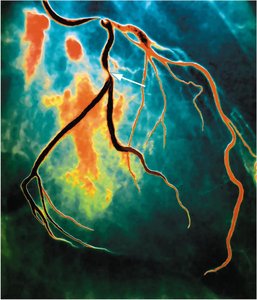
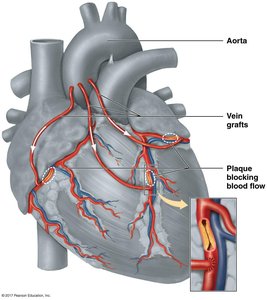
Angina is chest pain resulting from impaired blood flow to the heart, often due to narrowed coronary arteries. Symptoms include chest pain, tightness, shortness of breath, and a sensation of choking. Angina is usually temporary and relieved by rest or deep breaths.
Diagnosis: Angiography visualizes blood vessels after contrast injection.
Treatment: Medications to increase blood flow, balloon angioplasty to open blocked vessels.
Heart Attack (Myocardial Infarction)
A heart attack occurs when blood flow to an area of the heart stops long enough to cause tissue death due to oxygen deprivation. This results in permanent damage and impaired heart function.
Symptoms: Intense chest pain, tightness, shortness of breath, pain radiating down the left arm (more common in men); women may experience nausea, jaw pain, and back pain.
Diagnosis: Immediate ECG is required.
Treatment: Procedures such as coronary artery bypass graft (CABG) may be used to restore blood flow.
Heart Failure
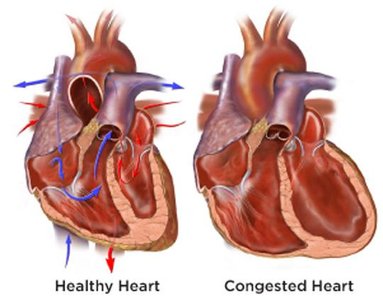
Heart failure occurs when the heart becomes less efficient at pumping blood, often due to damage to the heart muscle. This leads to fluid congestion, with increased capillary pressure causing fluid to leak into interstitial spaces, resulting in "congestive" heart failure.
Symptoms: Trouble breathing while lying down, shortness of breath, swollen ankles or legs, swollen neck veins, abdominal weight gain due to fluid retention.
Treatment: Mild exercise, diuretics, vasodilating drugs, drugs to strengthen heart contractions.
Embolism
An embolism is a sudden blockage of a blood vessel caused by material (such as a blood clot) traveling through the bloodstream. The location of the blockage determines the type (e.g., pulmonary, cerebral, cardiac embolism).
Stroke (Cerebrovascular Accident)
A stroke is caused by damage to blood vessels in the brain, resulting in interruption of blood supply. It is the brain equivalent of a heart attack and is the most common brain injury.
Causes: Embolism (blockage), rupture (bleeding of a cerebral artery).
Immediate medical care is crucial.
Reducing Risk of Cardiovascular Disease
Risk Factors
Risk factors for cardiovascular disease are classified as non-modifiable and modifiable.
Non-modifiable: Sex, race, age, genetics.
Modifiable: Lifestyle choices such as smoking, diet, salt intake, exercise, blood pressure management, body weight, diabetes control, stress, and certain medications.
Prevention Strategies
Do not smoke; smokers have more than twice the risk of heart attack.
Monitor cholesterol and salt intake.
Engage in regular moderate exercise (20–30 minutes, 3 times per week).
Seek treatment for high blood pressure.
Maintain a healthy weight and control diabetes.
Avoid chronic stress and be cautious with oral contraceptives and certain medications.
Additional info: Cardiovascular health is central to overall well-being, and understanding the mechanisms of regulation and common disorders is essential for prevention and management.
