 Back
Respiratory System: Structure, Function, and Regulation
Study Guide - Smart Notes
 Tailored notes based on your materials, expanded with key definitions, examples, and context.
Respiratory System
Overview of Respiration
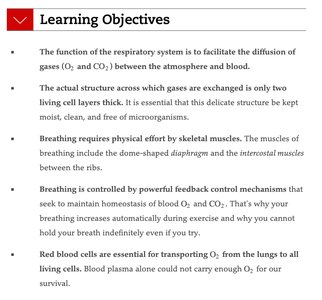
The respiratory system is essential for gas exchange, supplying oxygen (O2) to the body and removing carbon dioxide (CO2). Respiration involves several processes that ensure efficient gas exchange and energy production.
Breathing (Ventilation): The movement of air in and out of the lungs.
External Respiration: Exchange of gases between blood and inhaled air in the lungs.
Internal Respiration: Exchange of gases between blood and tissue fluids.
Cellular Respiration: Utilization of oxygen to produce ATP within cells.
Structure of the Respiratory System
The respiratory system is divided into upper and lower tracts, each with specialized functions for filtering, warming, and conducting air, as well as facilitating gas exchange.
Upper Respiratory Tract: Contains receptors for smell, filters and moistens air, and provides resonance for vocalization. The external nose and nasal cavity filter and trap particles, while sinuses produce mucus.
Pharynx: The throat, divided into nasopharynx (connects to auditory tubes) and oropharynx (passage for food).
Larynx: The voice box, maintains an open airway, routes food and air, and produces sound. The epiglottis prevents food from entering the trachea during swallowing.
Trachea: A tube supported by cartilage rings, lined with cilia and mucus to trap particles and prevent choking.
Bronchi and Bronchioles: Branches of the trachea that transport, clean, and warm air. Bronchioles lack cartilage and are susceptible to collapse in conditions like emphysema.
Lungs: Organs of gas exchange, enclosed by pleural membranes. The pleural cavity contains fluid to reduce friction.
Gas Exchange in the Alveoli
Gas exchange occurs in the alveoli, tiny air sacs at the ends of bronchioles. Alveoli are lined with epithelial cells and surfactant to reduce surface tension and prevent collapse.
Pulmonary Capillaries: Bring deoxygenated blood close to alveolar air for gas exchange.
Surfactant: A lipoprotein that prevents alveolar collapse, especially important in newborns.
Mechanics of Breathing
Breathing is driven by pressure gradients created by the diaphragm and intercostal muscles. Changes in thoracic cavity volume alter air pressure, causing inspiration and expiration.
Inspiration: Diaphragm contracts and flattens, intercostal muscles lift ribs, increasing thoracic volume and decreasing pressure, drawing air in.
Expiration: Muscles relax, thoracic volume decreases, pressure increases, and air is expelled.
Spirometer: Measures lung volumes and capacities, including tidal volume, vital capacity, inspiratory and expiratory reserve volumes, and residual volume.
Gas Exchange and Transport
Gas exchange is passive, driven by partial pressure gradients. Oxygen and carbon dioxide diffuse across membranes according to their partial pressures.
Partial Pressure: Each gas exerts a pressure proportional to its concentration. Gases diffuse from high to low partial pressure.
Hemoglobin: Transports oxygen (HbO2) and carbon dioxide (HbCO2). The binding of gases is reversible and dependent on partial pressures.
Carbon Dioxide Transport: 10% dissolved in plasma, 20% bound to hemoglobin, 70% converted to bicarbonate (HCO3-) via carbonic anhydrase.
Key Equations:
Hemoglobin binding:
CO2 transport:
Regulation of Breathing
Breathing is regulated by the respiratory center in the medulla oblongata and chemical receptors that monitor CO2, H+, and O2 levels.
Medulla Oblongata: Establishes basic breathing rhythm.
Chemoreceptors: Located in carotid and aortic bodies, respond to changes in blood gases.
Feedback Mechanisms: Maintain homeostasis of blood gases; increased CO2 or H+ stimulates increased respiration.
Disorders of the Respiratory System
Several disorders can affect respiratory function, including:
Asthma: Spasmodic contraction of bronchi.
Emphysema: Loss of elasticity in airways and alveoli.
Bronchitis: Inflammation of bronchi.
Cystic Fibrosis: Overproduction of mucus, clogging airways.
Pneumonia: Infection and inflammation of lung tissue.
Tuberculosis: Infection by Mycobacterium tuberculosis.
Botulism: Toxin blocks nerve signals to muscles.
Lung Cancer: Often linked to smoking and exposure to carcinogens.
Pneumothorax: Collapse of lung lobes due to air in pleural cavity.
Atelectasis: Collapse of alveoli, reducing gas exchange.
Congestive Heart Failure: Fluid buildup in lungs impairs gas diffusion.
Summary Table: Lung Volumes and Capacities
Volume/Capacity | Definition | Typical Value (ml) |
|---|---|---|
Tidal Volume | Amount of air inhaled/exhaled per breath | 500 |
Vital Capacity | Max exhaled after max inhalation | 4800 |
Inspiratory Reserve | Additional air inhaled beyond tidal volume | 2100-3200 |
Expiratory Reserve | Additional air exhaled beyond tidal volume | 1000-1200 |
Residual Volume | Air remaining after maximal exhalation | 1200 |
Dead Space Volume | Air not participating in gas exchange | 150 |
Additional info: The notes expand on the original content by providing definitions, context, and examples for each process and structure, as well as a summary table for lung volumes and capacities.
