Intermediate Algebra
My Course
Learn
AI Tutor
Study Guides
Flashcards
Explore
Try the app
My Course
Learn
AI Tutor
Study Guides
Flashcards
Explore
Try the app
Back
Absolute Value Inequalities quiz
You can tap to flip the card.
What is the first step when solving an absolute value inequality?
You can tap to flip the card.
👆
What is the first step when solving an absolute value inequality?
The first step is to isolate the absolute value expression on one side of the inequality.
Track progress
Control buttons has been changed to "navigation" mode.
1/15
Related flashcards
Recommended videos
Absolute Value Inequalities definitions
Absolute Value Inequalities
15 Terms
06:09
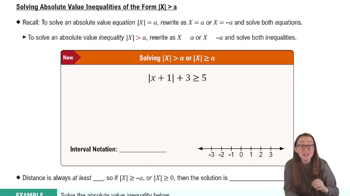
Solve Absolute Value Inequalities of the Form |X|>a
50
views
1
rank
03:19
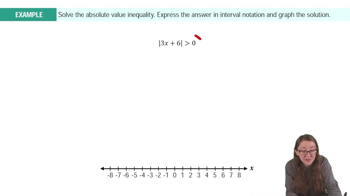
Solve Absolute Value Inequalities of the Form |X|>a Example 2
56
views
04:20
Solve Absolute Value Inequalities of the Form |X|<a Example 1
60
views
3
rank
Terms in this set (15)
Hide definitions
What is the first step when solving an absolute value inequality?
The first step is to isolate the absolute value expression on one side of the inequality.
How do you rewrite the inequality |x| < a, where a > 0, without absolute values?
You rewrite it as a three-part inequality: -a < x < a.
What does the inequality |x| > a mean in terms of two separate inequalities?
It means x > a or x < -a.
How do you solve |x + 1| ≤ 2?
Rewrite as -2 ≤ x + 1 ≤ 2, then solve for x to get -3 ≤ x ≤ 1.
What is the solution to |x + 1| < -1?
There is no solution because absolute value cannot be less than a negative number.
What is the solution to |x + 1| ≤ 0?
The solution is x + 1 = 0, so x = -1.
How do you express the solution -3 ≤ x ≤ 1 in interval notation?
It is written as [-3, 1].
What does a bracket [ ] mean in interval notation for absolute value inequalities?
A bracket means the endpoint is included in the solution set (less than or equal to, or greater than or equal to).
How do you solve |x + 1| ≥ 2?
Rewrite as x + 1 ≥ 2 or x + 1 ≤ -2, then solve to get x ≥ 1 or x ≤ -3.
What is the interval notation for the solution x ≥ 1 or x ≤ -3?
It is (-∞, -3] ∪ [1, ∞).
What happens if you have |x| < 0?
There is no solution because absolute value cannot be negative.
What is the solution to |x| ≥ 0?
The solution is all real numbers, since absolute value is always at least zero.
When solving a three-part inequality, what must you do to all three sides?
You must perform the same operation to all three sides to maintain the inequality.
How do you graph the solution to |x| < a on a number line?
Shade the region between -a and a, using open circles if the inequality is strict (<) or closed circles if it includes equality (≤).
What special case occurs when the number on the other side of the absolute value is negative in an inequality?
If the inequality is |x| < negative number, there is no solution; if |x| > negative number, the solution is all real numbers.