Intermediate Algebra
My Course
Learn
AI Tutor
Study Guides
Flashcards
Explore
Try the app
My Course
Learn
AI Tutor
Study Guides
Flashcards
Explore
Try the app
Back
Adding and Subtracting Rational Expressions with Common Denominators quiz
You can tap to flip the card.
What is the first step when adding or subtracting rational expressions with common denominators?
You can tap to flip the card.
👆
What is the first step when adding or subtracting rational expressions with common denominators?
Combine the numerators over the common denominator.
Track progress
Control buttons has been changed to "navigation" mode.
1/15
Related flashcards
Recommended videos
Adding and Subtracting Rational Expressions with Common Denominators definitions
Adding and Subtracting Rational Expressions with Common Denominators
15 Terms
04:35
Adding and Subtracting Rational Expressions with Common Denominators Example 1
53
views
5
rank
06:00
Adding and Subtracting Rational Expressions with Common Denominators
64
views
1
rank
Terms in this set (15)
Hide definitions
What is the first step when adding or subtracting rational expressions with common denominators?
Combine the numerators over the common denominator.
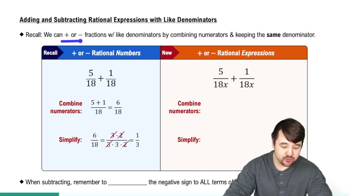
When adding 5/18 and 1/18, what do you do with the numerators and denominators?
Add the numerators (5 + 1) and keep the denominator the same (18).
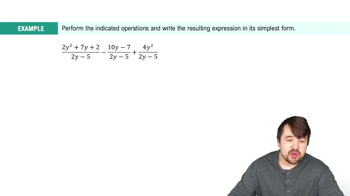
Why is it important to simplify your final answer when adding or subtracting rational expressions?
Simplifying ensures the answer is in its simplest form and may involve canceling common factors.
What must you remember to do when subtracting rational expressions?
Distribute the negative sign to all terms in the numerator of the second expression.
How do you simplify 6/18x?
Factor both numerator and denominator, cancel common factors, and the answer is 1/3x.
What is the result of adding 5/18x and 1/18x?
The result is 6/18x, which simplifies to 1/3x.
What is the common denominator in the expression x²/(x-1) - (–x+2)/(x-1)?
The common denominator is x - 1.
How do you combine the numerators when subtracting x²/(x-1) – (–x+2)/(x-1)?
Subtract the entire numerator of the second fraction from the first, distributing the negative sign.
After distributing the negative in x² – (–x + 2), what is the new numerator?
The new numerator is x² + x – 2.
How do you factor x² + x – 2?
Find two numbers that multiply to –2 and add to 1; these are –1 and 2, so it factors to (x–1)(x+2).
What happens to common factors in the numerator and denominator when simplifying rational expressions?
Common factors are canceled out to further simplify the expression.
What is the simplified form of (x–1)(x+2)/(x–1)?
The simplified form is x + 2.
Why is factoring quadratics important when simplifying rational expressions?
Factoring helps identify and cancel common factors, leading to the simplest form.
What is the general strategy for adding or subtracting rational expressions with common denominators?
Combine the numerators, keep the denominator, and simplify the result.
What should you always check for after combining rational expressions?
Always check if the expression can be simplified further by factoring and canceling common factors.