Intermediate Algebra
My Course
Learn
AI Tutor
Study Guides
Flashcards
Explore
Try the app
My Course
Learn
AI Tutor
Study Guides
Flashcards
Explore
Try the app
Back
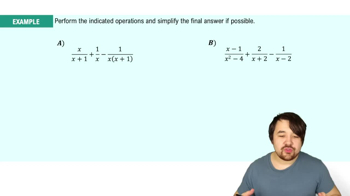
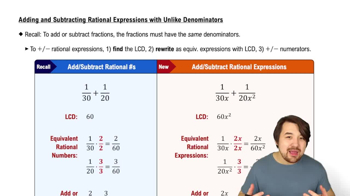
Adding and Subtracting Rational Expressions with Different Denominators definitions
You can tap to flip the card.
Rational Expression
You can tap to flip the card.
👆
Rational Expression
A fraction where both numerator and denominator are polynomials, often requiring simplification or manipulation.
Track progress
Control buttons has been changed to "navigation" mode.
1/15
Related flashcards
Recommended videos
Adding and Subtracting Rational Expressions with Different Denominators quiz
Adding and Subtracting Rational Expressions with Different Denominators
15 Terms
08:03
Adding and Subtracting Rational Expressions with Unlike Denominators Example 1
82
views
2
rank
06:23
Adding and Subtracting Rational Expressions with Unlike Denominators
116
views
2
rank
Terms in this set (15)
Hide definitions
Rational Expression
A fraction where both numerator and denominator are polynomials, often requiring simplification or manipulation.
Least Common Denominator
The smallest shared multiple of denominators, found by factoring and multiplying all unique factors present.
Binomial
An algebraic expression consisting of two distinct terms, often used in denominators for factoring.
Equivalent Expression
A rewritten form of an expression that maintains the same value, achieved by multiplying by missing factors.
Missing Factor
A component absent from a denominator, necessary for creating a common denominator in rational expressions.
Numerator
The top part of a fraction or rational expression, combined or simplified during addition or subtraction.
Denominator
The bottom part of a fraction or rational expression, often factored to find commonality for operations.
Polynomial
An expression made up of terms with variables and coefficients, forming the basis of rational expressions.
Coefficient
A numerical factor attached to a variable within a term, distributed and combined during simplification.
Like Terms
Terms sharing identical variable parts, combined to simplify numerators in rational expressions.
Standard Form
An arrangement of a polynomial or expression where terms are ordered by degree, aiding clarity and simplification.
Factoring
The process of breaking down expressions into products of simpler components, essential for finding common denominators.
Distribution
Applying a coefficient to each term inside parentheses, used to expand numerators before combining terms.
Simplification
The process of reducing an expression to its most concise form, often after combining like terms and factoring.
Rational Number
A number expressed as a fraction of two integers, serving as a model for operations with rational expressions.