Back

Composition of Functions quiz

Control buttons has been changed to "navigation" mode.
1/15
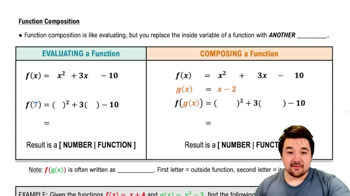
  • What does function composition involve when working with two functions f(x) and g(x)?

    Function composition involves replacing the variable in one function with another function, such as substituting g(x) into f(x) to create a new expression.
  • How do you write the composition of f and g using notation?

    The composition is written as f(g(x)), which can also be shown as (f ∘ g)(x).
  • In the composition f(g(x)), which function is considered the 'inside' function?

    g(x) is the inside function because it is substituted into f(x).
  • What is the result when you compose f(x) = x^2 + 3x - 10 with g(x) = x - 2 to form f(g(x))?

    The result is f(g(x)) = (x - 2)^2 + 3(x - 2) - 10, which simplifies to x^2 - x - 12.
  • What is the first step in composing f(x) and g(x) to form f(g(x))?

    Replace every x in f(x) with the expression g(x).
  • How do you simplify expressions like (x - 2)^2 when composing functions?

    You use the FOIL method to expand binomials, then combine like terms.
  • If f(x) = x + 4 and g(x) = x^2 - 3, what is f(g(x))?

    f(g(x)) = (x^2 - 3) + 4, which simplifies to x^2 + 1.
  • If f(x) = x + 4 and g(x) = x^2 - 3, what is g(f(x))?

    g(f(x)) = (x + 4)^2 - 3, which simplifies to x^2 + 8x + 13.
  • What is the difference between evaluating a function at a number and composing two functions?

    Evaluating at a number replaces x with a value, while composing replaces x with another function.
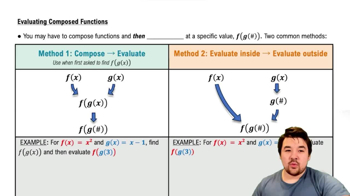
  • What are two methods for evaluating composed functions at a specific value?

    You can first compose the functions and then substitute the value, or evaluate the inside function at the value and then substitute that result into the outside function.
  • If f(x) = x^2 and g(x) = x - 1, what is f(g(x)) simplified?

    f(g(x)) = (x - 1)^2, which simplifies to x^2 - 2x + 1.
  • Using the shortcut method, how do you evaluate f(g(3)) for f(x) = x^2 and g(x) = x - 1?

    First, find g(3) = 2, then evaluate f(2) = 4.
  • Why might the shortcut method for evaluating composed functions not always be appropriate?

    Because sometimes you are required to find the composed function f(g(x)) before substituting a value, so the shortcut only works in certain cases.
  • What is the result of evaluating f(g(3)) for f(x) = x^2 and g(x) = x - 1 using the full composition method?

    First, compose to get x^2 - 2x + 1, then substitute x = 3 to get 4.
  • What does simplifying a composed function often reveal about the polynomial's structure?

    It shows terms in descending powers, helping you understand exponents, coefficients, and the degree of the resulting polynomial.