Back

Evaluating Exponents definitions

Control buttons has been changed to "navigation" mode.
1/15
  • Exponent Notation

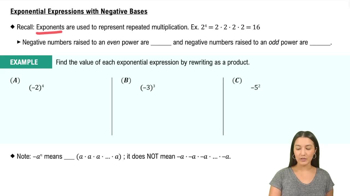
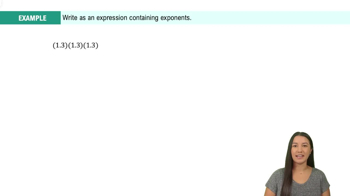
    A compact way to represent repeated multiplication using a base and a small number above it indicating how many times to multiply.
  • Base

    The number being repeatedly multiplied in an exponential expression, shown as the main value in exponent notation.
  • Exponent

    The small number above the base in exponent notation, indicating how many times the base is multiplied by itself.
  • Power

    The result of raising a base to an exponent, often described as the base to a certain value.
  • Squared

    A special term for raising a number to the second power, meaning the base is multiplied by itself twice.
  • Cubed

    A special term for raising a number to the third power, meaning the base is multiplied by itself three times.
  • Product

    The result of multiplying numbers together, often used when expanding exponential expressions.
  • Even Power

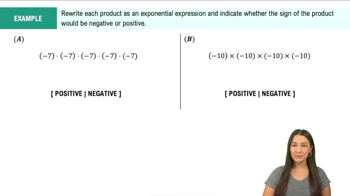
    An exponent that is an even number, which causes negative bases to result in positive values.
  • Odd Power

    An exponent that is an odd number, which causes negative bases to result in negative values.
  • Negative Base

    A base value less than zero in exponent notation, affecting the sign of the result depending on the exponent.
  • Parentheses

    Symbols used to clarify which part of an expression is the base, especially important with negative numbers.
  • Standard Form

    A way of writing expressions where each term is clearly shown, often used in polynomials and exponent notation.
  • Monomial

    An algebraic expression consisting of a single term, which may include a base raised to a power.
  • Polynomial

    An algebraic expression with multiple terms, each possibly containing bases raised to powers.
  • Repeated Multiplication

    The process of multiplying a number by itself several times, which exponent notation simplifies.