Back

Factoring by Greatest Common Factor & Grouping definitions

Control buttons has been changed to "navigation" mode.
1/15
  • Polynomial

    An expression made up of terms, each consisting of a coefficient, variable, and exponent, combined using addition or subtraction.
  • Greatest Common Factor

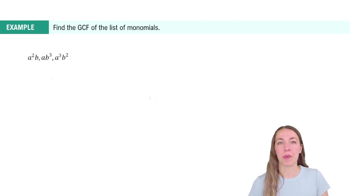
    The largest factor that evenly divides every term in a polynomial, including both numbers and variables.
  • Prime Factorization

    A breakdown of a number or term into a product of prime numbers and variables, often used to identify common factors.
  • Coefficient

    A numerical value multiplied by a variable in a term, indicating the term's magnitude.
  • Exponent

    A value showing how many times a variable is multiplied by itself within a term.
  • Term

    A single part of a polynomial, composed of a coefficient, variable, and possibly an exponent.
  • Binomial

    An expression consisting of exactly two terms joined by addition or subtraction.
  • Factored Form

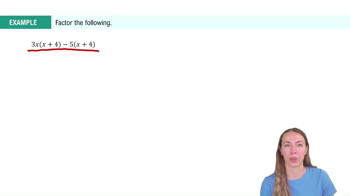
    A representation of a polynomial as a product of simpler expressions or factors.
  • Grouping

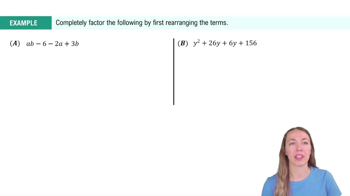
    A technique for factoring polynomials with four terms by pairing and extracting common factors from each pair.
  • Redistribution

    A process of multiplying factored expressions to verify the original polynomial is obtained.
  • FOIL Method

    A technique for multiplying two binomials by combining First, Outer, Inner, and Last terms.
  • Standard Form

    A way of writing a polynomial with terms ordered by descending exponents.
  • Variable

    A symbol representing an unknown value, often used with exponents and coefficients in polynomials.
  • Factor

    A number or variable that divides another term or expression without leaving a remainder.
  • Product

    The result of multiplying two or more numbers, terms, or expressions together.