Intermediate Algebra
My Course
Learn
AI Tutor
Study Guides
Flashcards
Explore
Try the app
My Course
Learn
AI Tutor
Study Guides
Flashcards
Explore
Try the app
Back
Introduction to Relations and Functions definitions
You can tap to flip the card.
Relation
You can tap to flip the card.
👆
Relation
Connection between inputs and outputs, often shown as ordered pairs, tables, graphs, or equations.
Track progress
Control buttons has been changed to "navigation" mode.
1/14
Related flashcards
Recommended videos
Introduction to Relations and Functions quiz
Introduction to Relations and Functions
15 Terms
02:49
Domain and Range Example 4
85
views
5
rank
03:04
Vertical Line Test
91
views
5
rank
05:08
Domain and Range
120
views
4
rank
Terms in this set (14)
Hide definitions
Relation
Connection between inputs and outputs, often shown as ordered pairs, tables, graphs, or equations.
Function
Special type of relation where each input is paired with exactly one output.
Input
Value from the set of x-values that is paired with an output in a relation or function.
Output
Value from the set of y-values that corresponds to an input in a relation or function.
Ordered Pair
Grouping of an input and output, written as (x, y), representing their correspondence.
Table
Arrangement of inputs and outputs in rows and columns to display a relation or function.
Graph
Visual representation of a relation or function, showing how inputs and outputs correspond.
Equation
Mathematical statement connecting inputs and outputs, often used to represent relations or functions.
Domain
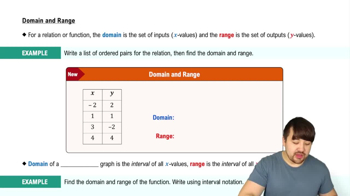
Set of all possible input values for a relation or function, often expressed as x-values.
Range
Set of all possible output values for a relation or function, often expressed as y-values.
Vertical Line Test
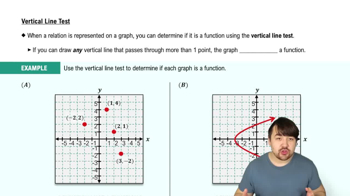
Method for identifying functions on a graph by checking if any vertical line crosses more than one point.
Interval Notation
Compact way to express all values within a range or domain, using brackets and parentheses.
Continuous Graph
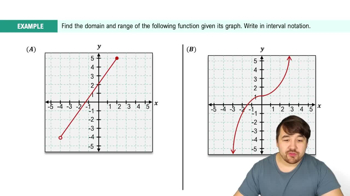
Graph with infinitely many points, allowing domain and range to be described using intervals.
Correspondence
Relationship showing how each input is linked to one or more outputs in a relation.