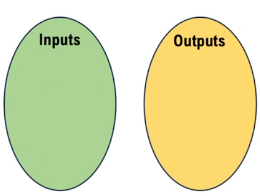
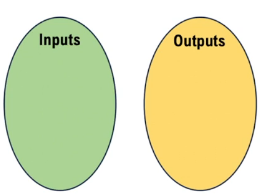
A relation is a fundamental concept in mathematics that describes a connection between inputs, often called x values, and outputs, known as y values. These connections are typically represented as sets of ordered pairs in the form \((x, y)\). To understand relations better, consider listing all the unique inputs and outputs from these pairs. For example, if you have ordered pairs like \((-2, 2)\), \((1, 1)\), \((3, -2)\), and \((1, 4)\), the inputs would be \(-2\), \(1\), and \(3\), while the outputs would be \(2\), \(1\), \(-2\), and \(4\). Visualizing these relations can be done by drawing arrows from each input to its corresponding output, illustrating how each value relates.
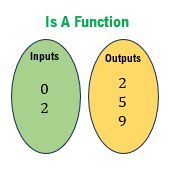
Functions are a special type of relation where each input is paired with exactly one output. This means no input value maps to more than one output. For instance, if you have ordered pairs like \((-4, 2)\), \((-2, -1)\), \((1, 2)\), and \((3, 4)\), each input corresponds to a single output, making this relation a function. In contrast, if an input like \(1\) maps to both \(1\) and \(4\), the relation is not a function. This distinction is crucial: all functions are relations, but not all relations are functions.
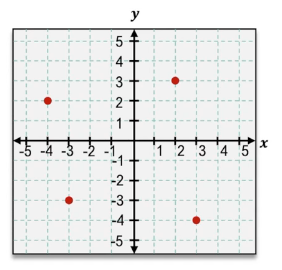
Relations and functions can be represented in various ways beyond ordered pairs. They can be shown as correspondences, tables, graphs, or equations, each providing a different perspective on how inputs and outputs relate. Understanding these representations helps in analyzing and interpreting mathematical relationships effectively.