Intermediate Algebra
My Course
Learn
AI Tutor
Study Guides
Flashcards
Explore
Try the app
My Course
Learn
AI Tutor
Study Guides
Flashcards
Explore
Try the app
Back
Least Common Denominators quiz
You can tap to flip the card.
What is the first step in finding the least common denominator (LCD) for rational expressions?
You can tap to flip the card.
👆
What is the first step in finding the least common denominator (LCD) for rational expressions?
The first step is to factor each denominator completely into prime factors and variables.
Track progress
Control buttons has been changed to "navigation" mode.
1/15
Related flashcards
Recommended videos
Least Common Denominators definitions
Least Common Denominators
15 Terms
06:33
Least Common Denominators of Rational Expressions
96
views
1
rank
03:32
Write Equivelant Expressions With Common Denominators Example 1
67
views
2
rank
03:28
Write Equivelant Expressions With Common Denominators Example 2
61
views
3
rank
Terms in this set (15)
Hide definitions
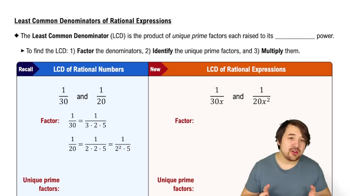
What is the first step in finding the least common denominator (LCD) for rational expressions?
The first step is to factor each denominator completely into prime factors and variables.
How do you determine which powers of each factor to use when finding the LCD?
You use the highest power of each unique factor present in any denominator.
What is the LCD of 30x and 20x^2?
The LCD is 60x^2, found by multiplying the highest powers of all unique factors: 3, 2^2, 5, and x^2.
Why do you only write each unique prime factor once when finding the LCD?
Because the LCD requires only the highest power of each unique factor, not repeated factors.
How do you handle variables like x when finding the LCD?
Include the variable raised to its highest power found in any denominator.
What is the process for finding the LCD of denominators like x + 5 and x^2 + 7x + 10?
Factor each denominator completely, then multiply the unique factors together to get the LCD.
How do you factor x^2 + 7x + 10?
It factors into (x + 2)(x + 5) because 2 and 5 multiply to 10 and add to 7.
What is the LCD for denominators x + 5 and (x + 2)(x + 5)?
The LCD is (x + 2)(x + 5), including each unique factor once.
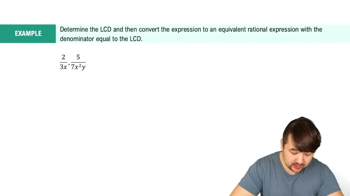
What is the next step after finding the LCD when writing equivalent rational expressions?
Identify the missing factors in each denominator compared to the LCD.
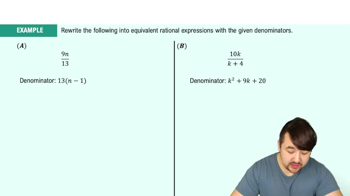
How do you rewrite a rational expression to have the LCD as its denominator?
Multiply both the numerator and denominator by the missing factors needed to reach the LCD.
If the LCD is 60, what missing factor does 30 need to reach the LCD?
30 needs a factor of 2 to reach 60, since 30 × 2 = 60.
If the LCD is 60, what missing factor does 20 need to reach the LCD?
20 needs a factor of 3 to reach 60, since 20 × 3 = 60.
How do you rewrite 1/30x to have a denominator of 60x^2?
Multiply numerator and denominator by 2x, resulting in 2x/60x^2.
How do you rewrite 1/20x^2 to have a denominator of 60x^2?
Multiply numerator and denominator by 3, resulting in 3/60x^2.
Why is finding the LCD important when adding or subtracting rational expressions?
It allows you to rewrite expressions with a common denominator, making addition or subtraction possible.