Intermediate Algebra
My Course
Learn
AI Tutor
Study Guides
Flashcards
Explore
Try the app
My Course
Learn
AI Tutor
Study Guides
Flashcards
Explore
Try the app
Back
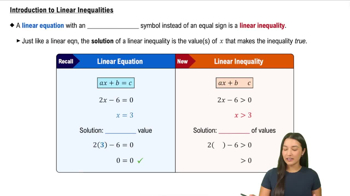
Linear Inequalities in One Variable definitions
You can tap to flip the card.
Linear Inequality
You can tap to flip the card.
👆
Linear Inequality
An expression involving an inequality symbol between linear terms, representing a range of possible values for a variable.
Track progress
Control buttons has been changed to "navigation" mode.
1/15
Related flashcards
Recommended videos
Linear Inequalities in One Variable quiz
Linear Inequalities in One Variable
15 Terms
03:43
Introduction to Linear Inequalities
220
views
4
rank
07:09
Introduction to Linear Inequalities Example 1
106
views
1
rank
08:24
Representing Solutions to Linear Inequalities
153
views
3
rank
Terms in this set (15)
Hide definitions
Linear Inequality
An expression involving an inequality symbol between linear terms, representing a range of possible values for a variable.
Inequality Symbol
A sign such as >, <, ≥, or ≤ used to compare values and indicate the relationship between expressions.
Solution Set
A collection of all values that satisfy a linear inequality, often shown as a range rather than a single value.
Set Builder Notation
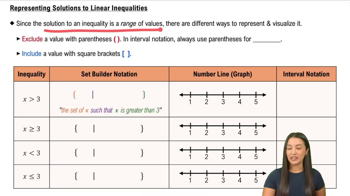
A format using curly brackets and a vertical line to describe all values meeting a specific inequality condition.
Interval Notation
A concise way to express ranges of solutions using parentheses or brackets to indicate inclusion or exclusion of endpoints.
Number Line
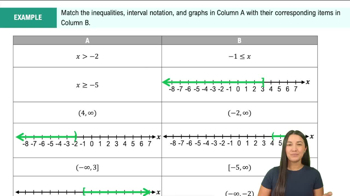
A visual representation of solution sets, using arrows, dots, or brackets to show included or excluded values.
Parenthesis
A symbol used in interval notation or graphs to indicate that a boundary value is not included in the solution set.
Square Bracket
A symbol used in interval notation or graphs to show that a boundary value is included in the solution set.
Open Circle
A graphical marker on a number line indicating a value is excluded from the solution set.
Closed Circle
A graphical marker on a number line indicating a value is included in the solution set.
Addition Property of Inequality
A rule allowing the same value to be added to both sides of an inequality without changing the solution set.
Subtraction Property of Inequality
A rule allowing the same value to be subtracted from both sides of an inequality without affecting the solution set.
Multiplication Property of Inequality
A rule permitting multiplication of both sides by a positive value, preserving the direction of the inequality.
Division Property of Inequality
A rule permitting division of both sides by a positive value, maintaining the direction of the inequality.
Symbol Flipping
A required change in the direction of the inequality sign when multiplying or dividing both sides by a negative value.