Back

Linear Inequalities in One Variable quiz

Control buttons has been changed to "navigation" mode.
1/15
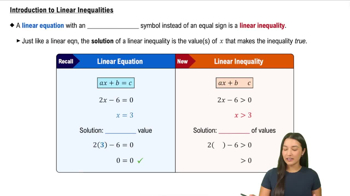
  • What is the main difference between a linear equation and a linear inequality?

    A linear equation uses an equal sign and has a single solution, while a linear inequality uses an inequality symbol and has a range of solutions.
  • What are the four common inequality symbols used in linear inequalities?

    The four common symbols are greater than (>), less than (<), greater than or equal to (≥), and less than or equal to (≤).
  • How is the solution to a linear inequality typically represented?

    The solution is a range of values that make the inequality true, not just a single value.
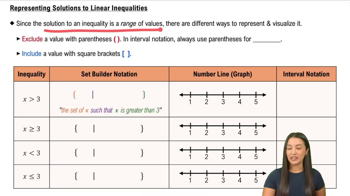
  • What is set builder notation for the solution x > 3?

    Set builder notation is {x | x > 3}, meaning the set of x such that x is greater than 3.
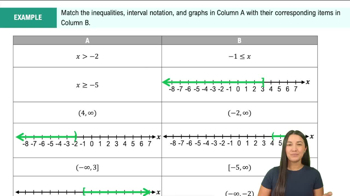
  • How do you indicate that a boundary point is excluded in interval notation?

    You use parentheses, for example (3, ∞) means 3 is not included.
  • How do you indicate that a boundary point is included in interval notation?

    You use square brackets, for example [3, ∞) means 3 is included.
  • What notation is always used for infinity in interval notation and why?

    Parentheses are always used for infinity because infinity is not an actual value and cannot be included.
  • How is x < 3 represented in interval notation?

    It is represented as (-∞, 3) with parentheses indicating that 3 is not included.
  • What is the graphical representation for x ≥ 3 on a number line?

    Start at 3 with a square bracket or closed circle and draw an arrow to the right, indicating all values greater than or equal to 3.
  • What is the key step when solving a linear inequality and you multiply or divide by a negative number?

    You must flip the inequality symbol to maintain correctness.
  • How do you solve x - 3 > 11?

    Add 3 to both sides to isolate x, resulting in x > 14.
  • What happens to the inequality symbol when you multiply or divide both sides by a positive number?

    The inequality symbol stays the same.
  • How do you solve -7x ≥ 21?

    Divide both sides by -7 and flip the inequality, resulting in x ≤ -3.
  • What is the set builder notation for x ≤ 3?

    It is {x | x ≤ 3}, meaning the set of x such that x is less than or equal to 3.
  • What is the difference between using parentheses and square brackets on a number line?

    Parentheses indicate the boundary point is excluded, while square brackets indicate it is included.