Back

Linear Inequalities in Two Variables definitions

Control buttons has been changed to "navigation" mode.
1/15
  • Linear Inequality

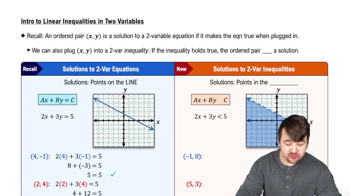
    A mathematical statement involving two variables and an inequality symbol, representing a region on a graph.
  • Ordered Pair

    A set of two numbers representing coordinates on a graph, used to test solutions for inequalities.
  • Solution Region

    The area on a graph where all points satisfy a given linear inequality.
  • Solid Line

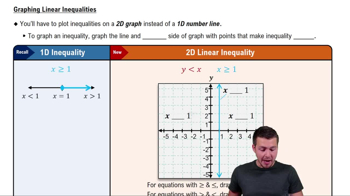
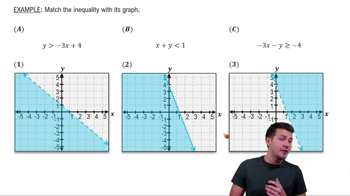
    A boundary on a graph drawn when the inequality includes equality, indicating points on the line are solutions.
  • Dashed Line

    A boundary on a graph drawn when the inequality excludes equality, indicating points on the line are not solutions.
  • Slope-Intercept Form

    A way to write a linear equation or inequality as y equals mx plus b, simplifying graphing and shading.
  • Inequality Symbol

    A sign such as <, >, ≤, or ≥ used to compare expressions and determine the solution region.
  • Y-Intercept

    The point where a line crosses the y-axis, useful for graphing linear inequalities.
  • Test Point

    A chosen coordinate used to check which side of a boundary satisfies the inequality.
  • Shaded Region

    The portion of a graph representing all solutions to a linear inequality.
  • Standard Form

    A linear equation or inequality written as ax plus by equals c or ax plus by compared to c.
  • Boundary Line

    The line separating solution and non-solution regions for a linear inequality.
  • X-Axis

    The horizontal axis on a graph, often used for selecting test points.
  • Y-Axis

    The vertical axis on a graph, often used for selecting test points.
  • Slope

    A measure of the steepness of a line, crucial for graphing linear inequalities.