Back

Linear Inequalities in Two Variables quiz

Control buttons has been changed to "navigation" mode.
1/15
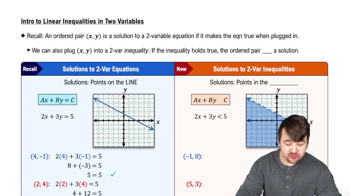
  • How do you determine if an ordered pair is a solution to a linear inequality in two variables?

    Plug the x and y values of the ordered pair into the inequality; if the statement is true, the pair is a solution.
  • What is the difference between the solution set of a linear equation and a linear inequality in two variables?

    A linear equation's solutions lie on a line, while a linear inequality's solutions form a region on the graph.
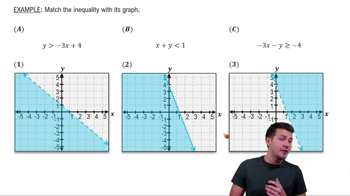
  • What type of line do you draw for the inequality y ≥ 2x - 4?

    You draw a solid line because the inequality includes 'equal to.'
  • What type of line do you draw for the inequality y > 2x - 4?

    You draw a dashed line because the inequality does not include 'equal to.'
  • How do you decide which side of the line to shade when graphing a linear inequality?

    Test a point not on the line (often (0,0) if possible); if it satisfies the inequality, shade that side.
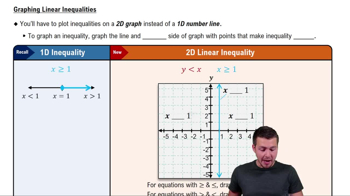
  • If the inequality is y < x, which side of the line y = x do you shade?

    You shade below the line y = x.
  • What does the shaded region represent in the graph of a linear inequality?

    It represents all the points (x, y) that satisfy the inequality.
  • What is the first step in graphing a linear inequality in two variables?

    Graph the corresponding line by replacing the inequality symbol with an equal sign.
  • When do you use a solid line versus a dashed line when graphing inequalities?

    Use a solid line for ≤ or ≥ and a dashed line for < or >.
  • How can you quickly determine which region to shade for inequalities in the form y > mx + b or y < mx + b?

    For y > mx + b, shade above the line; for y < mx + b, shade below the line.
  • If a point lies on the boundary line of a graphed inequality, when is it included in the solution set?

    It is included if the inequality is ≤ or ≥, but not if it is < or >.
  • What does it mean if plugging a point into a linear inequality gives a false statement?

    The point is not a solution and lies outside the shaded region.
  • How do you test if a point like (2, 0) is a solution to x ≥ 1?

    Plug x = 2 into the inequality; since 2 ≥ 1 is true, (2, 0) is a solution.
  • What is the shortcut for shading when the inequality is solved for y?

    If the inequality is y > (or ≥) something, shade above the line; if y < (or ≤), shade below.
  • Why is it often easier to test points on the axes when determining which region to shade?

    Because one of the variables will be zero, making calculations simpler.