Skip to main content
Intermediate Algebra
My Course
Learn
Exam Prep
AI Tutor
Study Guides
Flashcards
Explore
Try the app
My Course
Learn
Exam Prep
AI Tutor
Study Guides
Flashcards
Explore
Try the app
Back
Mixture Problem Solving definitions
You can tap to flip the card.
Mixture
You can tap to flip the card.
👆
Mixture
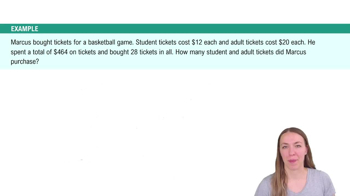
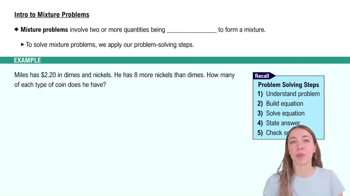
Combination of two or more distinct quantities to form a new total, often requiring calculation of individual parts.
Track progress
Control buttons has been changed to "navigation" mode.
1/15
Related flashcards
Related practice
Recommended videos
Mixture Problem Solving quiz
Mixture Problem Solving
15 Terms
Mixture Problem Solving
3. Solving Word Problems
5 problems
Topic
ErnestBlazevic
Percent Problem Solving
3. Solving Word Problems
5 problems
Topic
ErnestBlazevic
3. Solving Word Problems
4 topics
12 problems
Chapter
ErnestBlazevic
Guided course
05:55
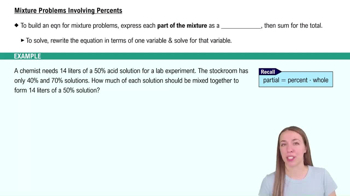
Mixture Problems Involving Percents
76
views
Guided course
03:19
Intro to Mixture Problems Example 1
99
views
Guided course
05:18
Intro to Mixture Problems
109
views
Terms in this set (15)
Hide definitions
Mixture
Combination of two or more distinct quantities to form a new total, often requiring calculation of individual parts.
Variable
Symbol representing an unknown quantity in an equation, used to express parts of a mixture.
Equation
Mathematical statement showing the relationship between mixture components and their total.
Percent
Ratio expressed as a fraction of 100, often converted to decimal for calculations in mixture problems.
Decimal
Numerical form used to represent percents in equations, facilitating multiplication and addition.
Product
Result of multiplying a quantity by its value or percent, representing a part of the mixture.
Sum
Total obtained by adding individual products of mixture components.
Distribution
Process of multiplying a value across terms within parentheses to simplify equations.
Isolation
Technique for rearranging an equation to solve for a single variable.
Substitution
Method of replacing one variable with an equivalent expression to reduce the number of unknowns.
Solution
Final answer indicating the required amounts of each component in a mixture.
Coefficient
Numerical factor multiplied by a variable in an equation, often representing value or percent.
Total Amount
Overall quantity resulting from combining all parts of a mixture, used as a reference in equations.
Partial Amount
Portion of the total, calculated by multiplying a percent or value by its corresponding quantity.
Context
Scenario or setting in which a mixture problem occurs, such as coins or chemical solutions.
 BackBack
 05:55
05:55