Back

Multiplying and Dividing Rational Expressions definitions

Control buttons has been changed to "navigation" mode.
1/15
  • Rational Expression

    A mathematical phrase with a numerator and denominator, both containing polynomials or numbers, often simplified by factoring and canceling.
  • Numerator

    The top part of a fraction or rational expression, representing the quantity being divided.
  • Denominator

    The bottom part of a fraction or rational expression, indicating the value by which the numerator is divided.
  • Prime Factor

    A basic building block of numbers or polynomials, used to break down expressions for simplification.
  • Difference of Squares

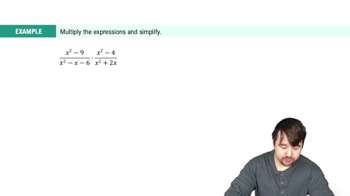
    A factoring pattern where two squared terms are subtracted, resulting in two binomial factors.
  • Reciprocal

    A flipped version of a fraction or rational expression, used in division to convert the operation to multiplication.
  • Simplification

    The process of reducing a rational expression to its most basic form by factoring and canceling common terms.
  • Common Factor

    A term or number present in both the numerator and denominator, which can be canceled to simplify expressions.
  • Quotient

    The result obtained after dividing one rational expression by another.
  • Divisor

    The expression or number by which another is divided in a rational expression.
  • Variable

    A symbol, often a letter, representing an unknown value in rational expressions.
  • Polynomial

    An algebraic expression consisting of variables and coefficients, used in both numerators and denominators.
  • Factoring

    The method of breaking down numbers or polynomials into simpler components to aid in simplification.
  • Multiplication

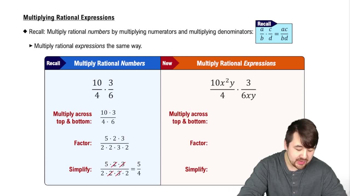
    The operation of combining numerators and denominators directly across to form a new rational expression.
  • Keep Change Flip

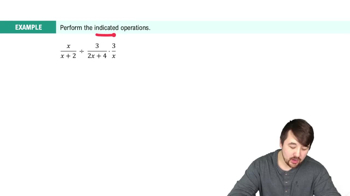
    A memory tool for division: retain the first expression, switch division to multiplication, and invert the second expression.