Intermediate Algebra
My Course
Learn
AI Tutor
Study Guides
Flashcards
Explore
Try the app
My Course
Learn
AI Tutor
Study Guides
Flashcards
Explore
Try the app
Back
Negative Exponents definitions
You can tap to flip the card.
Negative Exponent
You can tap to flip the card.
👆
Negative Exponent
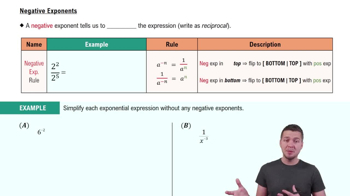
Indicates the reciprocal of a base raised to a positive exponent, allowing conversion to positive exponents by flipping the base.
Track progress
Control buttons has been changed to "navigation" mode.
1/14
Related flashcards
Recommended videos
Negative Exponents quiz
Negative Exponents
15 Terms
Guided course
04:10
Negative Exponents
69
views
1
rank
Guided course
05:56
Negative Exponents Example 1
51
views
2
rank
Terms in this set (14)
Hide definitions
Negative Exponent
Indicates the reciprocal of a base raised to a positive exponent, allowing conversion to positive exponents by flipping the base.
Reciprocal
Result of flipping a fraction, placing the denominator in the numerator and vice versa, often used to rewrite negative exponents.
Base
The number or variable that is repeatedly multiplied in an exponential expression, affected by exponent rules.
Exponent
A value showing how many times the base is multiplied by itself, can be positive or negative in algebraic expressions.
Fraction
An expression representing division, often used to demonstrate the effect of negative exponents in algebra.
Numerator
The top part of a fraction, where a negative exponent can be moved to the denominator to become positive.
Denominator
The bottom part of a fraction, where a negative exponent can be moved to the numerator to become positive.
Quotient Rule
A rule stating that exponents with the same base can be subtracted when dividing, often resulting in negative exponents.
Positive Exponent
Indicates repeated multiplication of the base, often achieved by converting negative exponents using reciprocal rules.
Variable
A symbol representing an unknown value, commonly used as a base in exponential expressions.
Expression
A mathematical phrase combining numbers, variables, and exponents, simplified using exponent rules.
Factor
A number or variable multiplied in an expression, often counted when expanding exponents.
Simplification
The process of rewriting expressions to their most reduced form, often by applying exponent rules.
Practice Problem
An example used to reinforce understanding of negative exponents and their conversion to positive exponents.