Intermediate Algebra
My Course
Learn
AI Tutor
Study Guides
Flashcards
Explore
Try the app
My Course
Learn
AI Tutor
Study Guides
Flashcards
Explore
Try the app
Back
Negative Exponents quiz
You can tap to flip the card.
What does a negative exponent indicate in an expression like 2^-3?
You can tap to flip the card.
👆
What does a negative exponent indicate in an expression like 2^-3?
A negative exponent indicates the reciprocal of the base raised to the corresponding positive exponent; for example, 2^-3 = 1/(2^3).
Track progress
Control buttons has been changed to "navigation" mode.
1/15
Related flashcards
Recommended videos
Negative Exponents definitions
Negative Exponents
14 Terms
Guided course
04:10
Negative Exponents
69
views
1
rank
Guided course
05:56
Negative Exponents Example 1
51
views
2
rank
Terms in this set (15)
Hide definitions
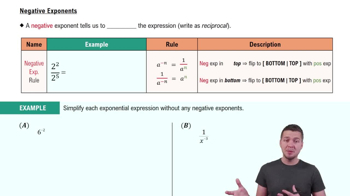
What does a negative exponent indicate in an expression like 2^-3?
A negative exponent indicates the reciprocal of the base raised to the corresponding positive exponent; for example, 2^-3 = 1/(2^3).
How do you rewrite 2^-3 with a positive exponent?
You rewrite 2^-3 as 1/(2^3), turning the negative exponent into a positive one in the denominator.
What is the general rule for converting a negative exponent to a positive exponent?
Flip the base to the opposite part of the fraction (numerator to denominator or vice versa) and change the exponent to positive.
How do you simplify 6^-2?
6^-2 simplifies to 1/(6^2), which equals 1/36.
If you have a negative exponent in the numerator, what should you do?
Move the base with the negative exponent to the denominator and make the exponent positive.
What do you do if the negative exponent is in the denominator?
Move the base with the negative exponent to the numerator and make the exponent positive.
How would you simplify 1/(x^-3)?
1/(x^-3) simplifies to x^3.
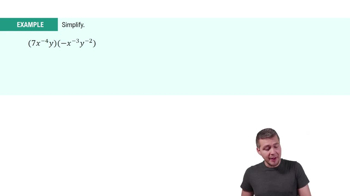
What is the simplified form of x^-4?
x^-4 simplifies to 1/(x^4).
What is the simplified form of 1/(y^-2)?
1/(y^-2) simplifies to y^2.
Why is there an 'invisible one' in the numerator when all terms cancel out?
When all terms cancel, the numerator becomes 1 because any number divided by itself is 1.
How does the quotient rule relate to negative exponents?
The quotient rule can result in a negative exponent when the exponent in the denominator is larger than in the numerator.
What does it mean to 'flip' an expression when dealing with negative exponents?
Flipping means moving the base with the negative exponent to the opposite part of the fraction and making the exponent positive.
Can you always rewrite a negative exponent as a positive exponent?
Yes, by moving the base to the opposite part of the fraction and changing the exponent to positive.
What is the simplified form of (a/b)^-n?
(a/b)^-n simplifies to (b/a)^n.
Why is understanding negative exponents important in algebra?
It helps in simplifying and manipulating exponential expressions, polynomials, and rational expressions.