Skip to main content
Intermediate Algebra
My Course
Learn
Exam Prep
AI Tutor
Study Guides
Flashcards
Explore
Try the app
My Course
Learn
Exam Prep
AI Tutor
Study Guides
Flashcards
Explore
Try the app
Back
Quadratic Equations & Applications quiz
You can tap to flip the card.
What is the standard form of a quadratic equation?
You can tap to flip the card.
👆
What is the standard form of a quadratic equation?
The standard form is ax^2 + bx + c = 0, where a, b, and c are constants.
Track progress
Control buttons has been changed to "navigation" mode.
1/15
Related flashcards
Related practice
Recommended videos
Quadratic Equations & Applications definitions
Quadratic Equations & Applications
15 Terms
Quadratic Equations & Applications
7. Factoring
5 problems
Topic
AllySteele
Factoring Special Products
7. Factoring
5 problems
Topic
ErnestBlazevic
7. Factoring - Part 1 of 2
4 topics
12 problems
Chapter
ErnestBlazevic
7. Factoring - Part 2 of 2
1 topic
3 problems
Chapter
ErnestBlazevic
Guided course
02:49
Applications of Quadratic Equations Example 2
119
views
2
rank
Guided course
05:56
Applications of Quadratic Equations
104
views
4
rank
Guided course
04:41
Solving Quadratic Equations by Factoring
193
views
4
rank
Terms in this set (15)
Hide definitions
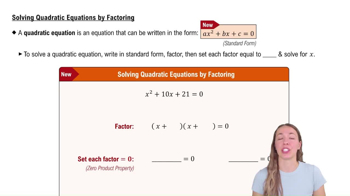
What is the standard form of a quadratic equation?
The standard form is ax^2 + bx + c = 0, where a, b, and c are constants.
What does it mean to solve a quadratic equation?
It means finding the values of x that make the equation true, typically making the expression equal to zero.
What is the first step in solving a quadratic equation?
The first step is to write the equation in standard form.
How do you factor a quadratic equation in standard form?
You look for two numbers that multiply to c and add to b, then write the equation as a product of two binomials.
What property allows you to set each factor of a factored quadratic equation equal to zero?
The zero product property allows you to set each factor equal to zero.
After factoring, what do you do to solve for x?
Set each factor equal to zero and solve for x.
How can you check if your solutions to a quadratic equation are correct?
Plug the solutions back into the original equation to see if they make the equation true (equal to zero).
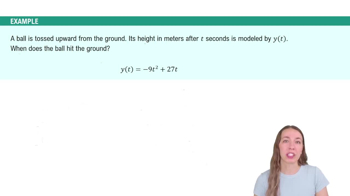
What real-world situations can quadratic equations model?
Quadratic equations can model projectile motion, business profit analysis, and area problems, among others.
In the example x^2 + 10x + 21 = 0, what are the solutions for x?
The solutions are x = -3 and x = -7.
What is the area formula for a rectangle used in quadratic applications?
The area is length times width (A = l × w).
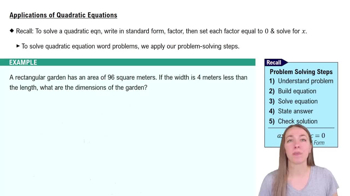
If the width of a rectangle is 4 meters less than the length and the area is 96 m^2, what quadratic equation models this situation?
The equation is l^2 - 4l - 96 = 0.
How do you determine which solution to use in a real-world quadratic problem?
Choose the solution that makes sense in context, such as a positive length for a physical object.
What are the dimensions of a rectangle with area 96 m^2 and width 4 meters less than its length?
The length is 12 meters and the width is 8 meters.
Why is it important to verify your solution in a quadratic application problem?
Verification ensures the solution fits the context and satisfies the original equation.
What key concepts are reinforced by solving quadratic equations?
Key concepts include understanding coefficients, terms, exponents, and the structure of polynomials.
 BackBack

 02:49
02:49