Intermediate Algebra
My Course
Learn
AI Tutor
Study Guides
Flashcards
Explore
Try the app
My Course
Learn
AI Tutor
Study Guides
Flashcards
Explore
Try the app
Back
Set Operations and Compound Inequalities quiz
You can tap to flip the card.
What does the intersection (∩) of two sets represent?
You can tap to flip the card.
👆
What does the intersection (∩) of two sets represent?
The intersection represents all elements that are common to both sets.
Track progress
Control buttons has been changed to "navigation" mode.
1/15
Related flashcards
Recommended videos
Set Operations and Compound Inequalities definitions
Set Operations and Compound Inequalities
15 Terms
04:35
Solving Three Part Inequalities Example 4
58
views
1
rank
02:04
Intersection and Union of Sets Example 2
113
views
2
rank
01:41
Intersection and Union of Sets Example 1
122
views
Terms in this set (15)
Hide definitions
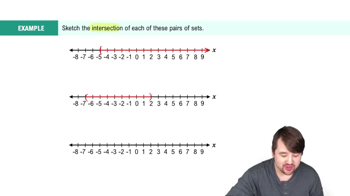
What does the intersection (∩) of two sets represent?
The intersection represents all elements that are common to both sets.
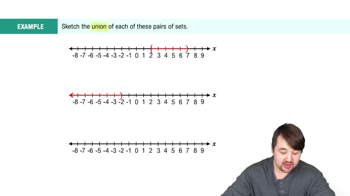
What does the union (∪) of two sets represent?
The union includes all elements from either set, without repeating any elements.
Which word in a compound inequality indicates you should find the intersection of solution sets?
The word 'and' indicates you should find the intersection of solution sets.
Which word in a compound inequality indicates you should find the union of solution sets?
The word 'or' indicates you should find the union of solution sets.
How do you solve a compound inequality linked by 'and'?
Solve each inequality separately, graph their solution sets, and find the overlap (intersection) between them.
How do you solve a compound inequality linked by 'or'?
Solve each inequality separately, graph their solution sets, and combine all values from both sets (union).
What is the solution set for the intersection of A = {1, 3, 5, 7, 9} and B = {7, 9, 11, 13}?
The intersection is {7, 9}.
What is the solution set for the union of A = {1, 3, 5, 7, 9} and B = {7, 9, 11, 13}?
The union is {1, 3, 5, 7, 9, 11, 13}.
How is the empty set represented in set notation?
The empty set is represented by empty brackets {} or the symbol ∅.
When graphing x < 2, do you use a bracket or a parenthesis at 2?
You use a parenthesis at 2 because 2 is not included in the solution.
When graphing x ≥ -1, do you use a bracket or a parenthesis at -1?
You use a bracket at -1 because -1 is included in the solution.
What is the interval notation for the solution to -2 ≤ x < 6?
The interval notation is [-2, 6).
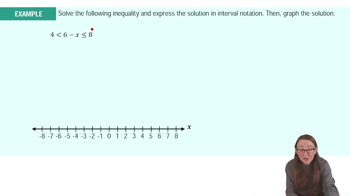
What must you do to all sides when solving a three-part inequality?
You must perform the same operation on all three sides of the inequality.
How do you write the solution to a three-part inequality in set builder notation?
Use curly brackets with the variable, a vertical bar, and the compound inequality, e.g., {x | -2 ≤ x < 6}.
What is the main difference between solving simple inequalities and three-part inequalities?
For three-part inequalities, every operation must be applied to all three sides, not just two.