Back

Simplifying Rational Expressions definitions

Control buttons has been changed to "navigation" mode.
1/15
  • Rational Expression

    A quotient of two polynomials, where the denominator must not be zero to avoid undefined values.
  • Numerator

    The polynomial above the fraction bar in a rational expression, often labeled as p.
  • Denominator

    The polynomial below the fraction bar in a rational expression, often labeled as q.
  • Domain

    The set of all real numbers for which a rational expression is defined, excluding values causing division by zero.
  • Factoring

    The process of breaking down a polynomial into products of simpler expressions or numbers.
  • Common Factor

    An expression or number present in both the numerator and denominator, which can be canceled during simplification.
  • Rational Function

    A function defined by a rational expression, with domain restrictions based on the denominator.
  • Interval Notation

    A method for expressing the domain, using parentheses and brackets to show excluded and included values.
  • Set Builder Notation

    A format for describing the domain, specifying conditions for valid values of the variable.
  • Greatest Common Factor

    The largest expression or number that divides all terms in a polynomial, used for factoring.
  • Conjugate

    A pair of expressions in the form a+b and a−b, which are not considered opposites in simplification.
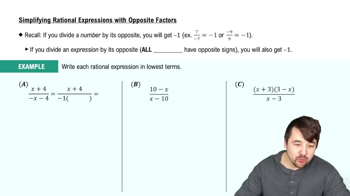
  • Opposite Factors

    Expressions where every term has the opposite sign, resulting in a simplified value of negative one.
  • Undefined Value

    A result occurring when the denominator equals zero, making the rational expression invalid.
  • Lowest Terms

    The simplest form of a rational expression after all common factors have been canceled.
  • Prime Factorization

    Breaking down a number or polynomial into its basic building blocks, such as prime numbers or irreducible expressions.