Back

Simplifying Rational Expressions quiz

Control buttons has been changed to "navigation" mode.
1/15
  • What is a rational expression?

    A rational expression is a quotient of two polynomials, where the denominator cannot be zero.
  • Why must the denominator of a rational expression not be zero?

    Because dividing by zero is undefined in mathematics, so any value that makes the denominator zero is excluded from the domain.
  • How do you find the domain of a rational function?

    Set the denominator equal to zero and solve for x; exclude these values from the domain.
  • What is the domain of f(x) = x - 1 / (2x - 6)?

    The domain is all real numbers except x = 3, since 2x - 6 = 0 when x = 3.
  • How do you evaluate a rational function at a specific value?

    Substitute the given value for x in the function and simplify the resulting expression.
  • What is the result of evaluating f(x) = x - 1 / (2x - 6) at x = 2?

    The result is -1/2, since substituting x = 2 gives 1 / -2.
  • What is the first step in simplifying a rational expression?

    Factor the numerator and denominator completely.
  • After factoring, what do you do to simplify a rational expression?

    Cancel any common factors in the numerator and denominator.
  • How do you simplify 28x^3 / 35x^5?

    Factor and cancel common factors to get 4 / (5x^2).
  • What is the simplified form of (x + 2)(x - 2) / (x + 6)(x + 2)?

    The simplified form is (x - 2) / (x + 6), after canceling x + 2.
  • How do you factor 3x^2 - 15x?

    Factor out the greatest common factor, 3x, to get 3x(x - 5).
  • What is the simplified form of (x - 5) / (3x^2 - 15x)?

    The simplified form is 1 / (3x), after factoring and canceling x - 5.
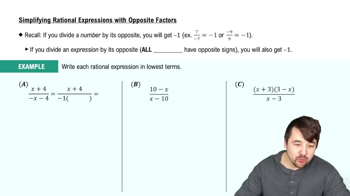
  • What happens when you divide an expression by its opposite?

    You get -1, as all terms have opposite signs and cancel out except for the negative.
  • Are x + 3 and x - 3 considered opposite factors?

    No, they are conjugates, not opposites, because not all terms have opposite signs.
  • How can you check if two expressions are opposites?

    Factor out a negative one and see if all terms change signs; if so, they are opposites.