Intermediate Algebra
My Course
Learn
AI Tutor
Study Guides
Flashcards
Explore
Try the app
My Course
Learn
AI Tutor
Study Guides
Flashcards
Explore
Try the app
Back
Solving Linear Equations quiz
You can tap to flip the card.
What is the standard form of a linear equation?
You can tap to flip the card.
👆
What is the standard form of a linear equation?
The standard form is ax + b = c, where a, b, and c are real numbers and a ≠ 0.
Track progress
Control buttons has been changed to "navigation" mode.
1/15
Related flashcards
Recommended videos
Solving Linear Equations definitions
Solving Linear Equations
15 Terms
05:27
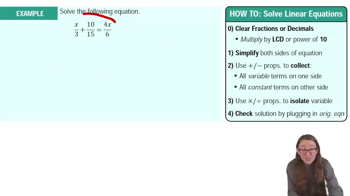
Solving Linear Equations with Fraction or Decimal Coefficients Example 7
86
views
06:00
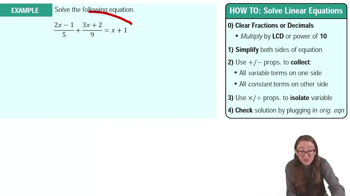
Solving Linear Equations with Fraction or Decimal Coefficients Example 6
80
views
06:24
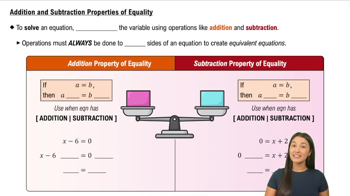
Addition and Subtraction Properties of Equality
176
views
1
rank
Terms in this set (15)
Hide definitions
What is the standard form of a linear equation?
The standard form is ax + b = c, where a, b, and c are real numbers and a ≠ 0.
What does it mean for a value to be a solution to a linear equation?
A solution is a value for the variable that makes the equation true when substituted back into the equation.
How can you verify that a value is a solution to a linear equation?
Substitute the value into the original equation and check if both sides are equal.
What is the addition property of equality?
It states that if a = b, then a + c = b + c for any value c.
When should you use the addition property of equality when solving equations?
Use it when you need to cancel out subtraction in order to isolate the variable.
What is the subtraction property of equality?
If a = b, then a - c = b - c for any value c.
When should you use the subtraction property of equality?
Use it to cancel out addition when isolating the variable.
What is the multiplication property of equality?
If a = b, then a × c = b × c for any value c.
How do you solve an equation with a fractional coefficient, like (3/4)x = 9?
Multiply both sides by the reciprocal of the fraction, in this case 4/3, to isolate x.
What is the first step when solving an equation with fractions?
Multiply both sides by the least common denominator (LCD) to clear the fractions.
How do you clear decimals from an equation before solving?
Multiply both sides by a power of 10 that moves all decimal points to the right until you have whole numbers.
What are the three possible types of solution sets for a linear equation?
A linear equation can have one solution (conditional), infinite solutions (identity), or no solution (contradiction/inconsistent).
What is an identity equation?
An identity equation is true for all real numbers, so its solution set is all real numbers.
What is a contradiction or inconsistent equation?
It is an equation that is never true, so its solution set is the empty set.
What are the main steps to solve any linear equation?
Simplify both sides, collect variable terms on one side and constants on the other, isolate the variable, and check the solution.