Skip to main content
Intermediate Algebra
My Course
Learn
Exam Prep
AI Tutor
Study Guides
Flashcards
Explore
Try the app
My Course
Learn
Exam Prep
AI Tutor
Study Guides
Flashcards
Explore
Try the app
Back
Solving Systems of Linear Equations by Graphing definitions
You can tap to flip the card.
System of Equations
You can tap to flip the card.
👆
System of Equations
A collection of two or more equations requiring a single set of values to satisfy all simultaneously.
Track progress
Control buttons has been changed to "navigation" mode.
1/15
Related flashcards
Related practice
Recommended videos
Solving Systems of Linear Equations by Graphing quiz
Solving Systems of Linear Equations by Graphing
15 Terms
Solving Systems of Linear Equations by Substitution
5. Systems of Linear Equations
5 problems
Topic
ErnestBlazevic
5. Systems of Linear Equations
3 topics
9 problems
Chapter
AllySteele
Guided course
06:06
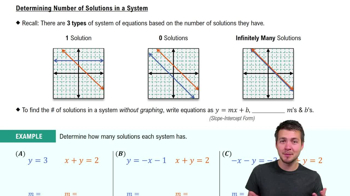
Determining Number of Solutions in a System
182
views
7
rank
Guided course
4:27
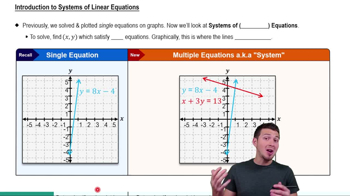
Introduction to Systems of Linear Equations
385
views
3
rank
Guided course
07:11
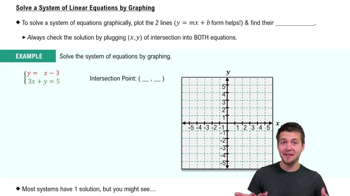
Solve a System of Linear Equations by Graphing
287
views
4
rank
Terms in this set (15)
Hide definitions
System of Equations
A collection of two or more equations requiring a single set of values to satisfy all simultaneously.
Linear Equation
An equation whose graph forms a straight line, typically written in slope-intercept or standard form.
Slope-Intercept Form
A format for expressing equations as y = mx + b, highlighting both slope and y-intercept.
Standard Form
An arrangement of equations as Ax + By = C, often requiring conversion for graphing.
Intersection Point
The coordinate where two lines cross, representing the solution to a system.
Slope
A measure of a line’s steepness, indicating the rate of change between x and y.
Y-Intercept
The location where a line crosses the y-axis, revealing the value of y when x is zero.
Parallel Lines
Lines with identical slopes but different y-intercepts, never meeting and yielding no solution.
Consistent System
A system with at least one solution, where lines intersect or overlap.
Inconsistent System
A system with no solution, typically represented by parallel lines.
Independent System
A system where lines intersect at a single point, each line distinct.
Dependent System
A system where lines coincide, resulting in infinitely many solutions.
Solution Set
All coordinate pairs that satisfy every equation in a system.
Graphing
A visual method for representing equations and identifying intersection points.
Coordinate Pair
An ordered pair (x, y) representing a point on the graph.
 BackBack

 06:06
06:06