Back

The Distributive Property quiz

Control buttons has been changed to "navigation" mode.
1/15
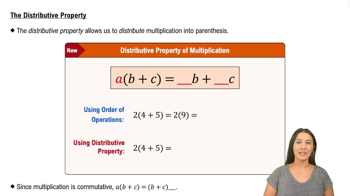
  • What does the distributive property allow us to do with multiplication and parentheses?

    It allows us to distribute multiplication across all terms inside the parentheses, whether they are added or subtracted.
  • How is the distributive property written for addition?

    a(b + c) = ab + ac.
  • How is the distributive property written for subtraction?

    a(b - c) = ab - ac.
  • Why does the distributive property work for subtraction as well as addition?

    Because subtraction can be thought of as adding a negative number, so the property applies similarly.
  • What is the result of applying the distributive property to 2(4 + 5)?

    2(4 + 5) = 2×4 + 2×5 = 8 + 10 = 18.
  • Why might you need to use the distributive property instead of just following the order of operations?

    Because the terms inside the parentheses may include variables, making addition or subtraction impossible without distribution.
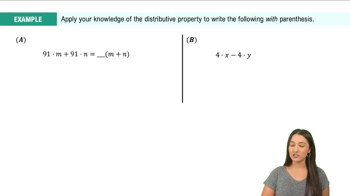
  • How do you apply the distributive property to 4(x - 8)?

    Distribute 4 to both x and 8: 4x - 32.
  • What is the simplified form of 4(x - 8) after applying the distributive property?

    4x - 32.
  • Does the distributive property work if the constant is on the right side of the parentheses?

    Yes, because multiplication is commutative, so the order does not matter.
  • How do you apply the distributive property to (4x + 2y - 7z) × 3?

    Distribute 3 to each term: 12x + 6y - 21z.
  • What is the simplified form of (4x + 2y - 7z) × 3?

    12x + 6y - 21z.
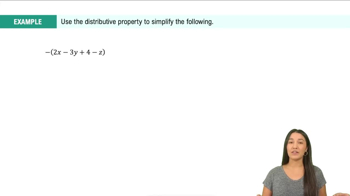
  • Can the distributive property be used with more than two terms inside the parentheses?

    Yes, it can be applied to any number of terms inside the parentheses.
  • What does it mean that multiplication is commutative in the context of the distributive property?

    It means the order of multiplication does not affect the result, so the constant can be on either side of the parentheses.
  • Why is the distributive property important for simplifying expressions with variables?

    It allows us to multiply across terms when addition or subtraction cannot be performed due to unknown variables.
  • What should you pay attention to when applying the distributive property to expressions with subtraction?

    You must distribute the multiplication to each term and keep the subtraction sign with the correct term.