 Back
Atomic Structure, Chemical Bonding, and Molecular Diversity in Introductory Biology
Study Guide - Smart Notes
 Tailored notes based on your materials, expanded with key definitions, examples, and context.
Levels of Organization in Biology
Hierarchical Structure of Biological Systems
Biological systems are organized in a hierarchy from the smallest subatomic particles to the entire organism. Understanding these levels is fundamental to studying biology.
Subatomic: Electrons, protons, neutrons
Atomic: Individual atoms (e.g., O, H, C)
Molecular: Molecules (e.g., O2, H2O, CO2)
Organelles: Structures within cells (e.g., nucleus, mitochondrion)
Cellular: Individual cells (e.g., skin cell)
Tissues: Groups of similar cells (e.g., smooth muscle tissue)
Organs: Structures composed of tissues (e.g., liver)
Systems: Groups of organs working together (e.g., digestive system)
Organism: Complete living entity (e.g., Homo sapiens)
The Chemical Basis of Life
Biochemistry and Organic Molecules
Biochemistry is a branch of organic chemistry focusing on molecules containing both carbon and hydrogen. These molecules are essential for life.
Organic molecules: Must contain both carbon and hydrogen (e.g., CH4, C6H12O6, C6H6)
Electron Configuration and Covalent Bonding
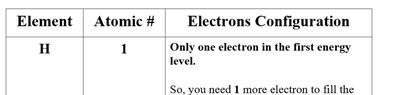
Atoms form covalent bonds to achieve stable electron configurations. The number of bonds formed depends on the number of electrons needed to fill the outermost energy level.
Element | Atomic # | Electrons Configuration |
|---|---|---|
H | 1 | Only one electron in the first energy level. Needs 1 more electron to fill the level, hence one covalent bond. |
C | 6 | 2, 4. Needs 4 more electrons to fill the second energy level, hence four covalent bonds. |
O | 8 | 2, 6. Needs 2 more electrons to fill the second energy level, hence two covalent bonds. |
N | 7 | 2, 5. Needs 3 more electrons to fill the second energy level, hence three covalent bonds. |
S | 16 | 2, 8, 6. Needs 2 more electrons to fill the third energy level, hence two covalent bonds. |
The Molecules of Cells
Types of Chemical Bonds
Chemical bonds are essential for the formation of molecules. The main types include nonpolar covalent, polar covalent, ionic, and hydrogen bonds.
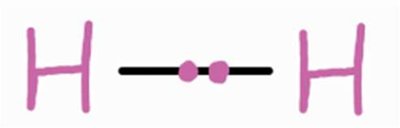
Nonpolar covalent bond: Equal sharing of electrons between atoms. Example: H2.
Polar covalent bond: Unequal sharing of electrons, with electrons closer to the more electronegative atom. Example: HF.

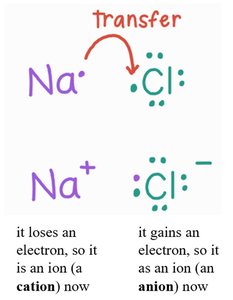
Ionic bond: One atom loses electrons (becomes a cation), another gains electrons (becomes an anion). Example: NaCl.
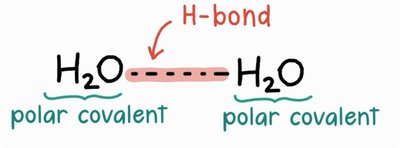
Hydrogen bond: Weak attraction between a partially positive hydrogen atom and a partially negative atom (e.g., O, N).
Bonding in Water and Ammonia
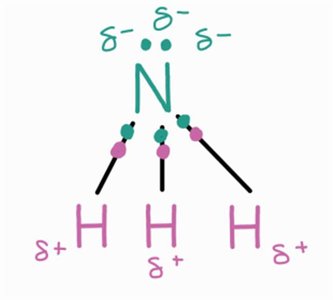
Water and ammonia are examples of polar molecules, with hydrogen bonding playing a crucial role in their properties.
Water (H2O): Polar covalent bonds within the molecule; hydrogen bonds between molecules.
Ammonia (NH3): Polar covalent bonds; hydrogen bonding with water.
The Chemical Properties of Elements
Atomic Number and Mass Number
Each element is defined by its atomic number (number of protons). The mass number is the sum of protons and neutrons.
Atomic number: Unique to each element; equals the number of protons.
Mass number: Number of protons plus number of neutrons.
Example:
Isotopes
Isotopes are forms of the same element with different numbers of neutrons, resulting in different mass numbers.
Examples: C12, C13, C14 (all have 6 protons, but different neutrons)
O16 and O18 (both have 8 protons, but different neutrons)
H1, H2, H3 (all have 1 proton, but 0, 1, or 2 neutrons)
Electron Distribution and Ion Formation
Formation of Ions
Atoms gain or lose electrons to achieve stable electron configurations, forming ions.
Cation: Positive ion formed by losing electrons (e.g., Na+)
Anion: Negative ion formed by gaining electrons (e.g., Cl-)
Electron Distribution Examples
Electron distribution determines the stability and bonding of atoms and ions.
Sodium atom: 2, 8, 1; Sodium ion: 2, 8
Chlorine atom: 2, 8, 7; Chlorine ion: 2, 8, 8
Magnesium atom: 2, 8, 2; Magnesium ion: 2, 8
Calcium atom: 2, 8, 8, 2; Calcium ion: 2, 8, 8
Potassium atom: 2, 8, 8, 1; Potassium ion: 2, 8, 8
Cohesion and Adhesion
Properties of Water and Other Polar Molecules
Cohesion and adhesion are important properties resulting from hydrogen bonding.
Cohesion: Attraction between like molecules (e.g., water molecules sticking together)
Adhesion: Attraction between unlike molecules (e.g., water and ammonia)
Structural Isomers
Molecular Diversity
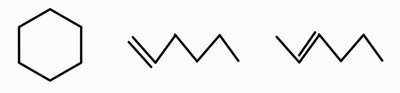
Structural isomers are molecules with the same molecular formula but different structures.
Example: Cyclohexane and its isomers (C6H12)
Sample Questions and Practice
Understanding Atomic Structure and Bonding
Practice questions reinforce concepts such as electron configuration, ion formation, isotopes, and chemical bonding.
How many electrons does a sodium ion have? Answer: 10
How many electrons does a chloride ion have? Answer: 18
How many electrons does a magnesium ion have? Answer: 10
How many electrons does a calcium ion have? Answer: 18
How many protons does 19K39 have? Answer: 19
How many neutrons does 19K39 have? Answer: 20
How many electrons does an ion of 19K39 have? Answer: 18
Summary Table: Atomic and Mass Numbers
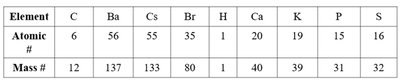
This table summarizes atomic and mass numbers for selected elements, useful for calculating protons, electrons, and neutrons.
Element | C | Ba | Cs | Br | H | Ca | K | P | S |
|---|---|---|---|---|---|---|---|---|---|
Atomic # | 6 | 56 | 55 | 35 | 1 | 20 | 19 | 15 | 16 |
Mass # | 12 | 137 | 133 | 80 | 1 | 40 | 39 | 31 | 32 |
Additional info:
Organic chemistry conventions often omit explicit carbon and hydrogen atoms in structural diagrams; these are implied at each vertex and line ending.
Counting shared electrons in molecular structures can be done by counting lines (each line represents a pair of electrons).
