 Back
Chapter 10: The Structure and Function of DNA – Study Notes
Study Guide - Smart Notes
 Tailored notes based on your materials, expanded with key definitions, examples, and context.
DNA: Structure and Replication
Historical Context and Discovery
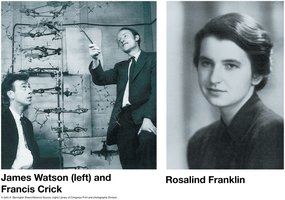
DNA (deoxyribonucleic acid) was recognized as a cellular chemical component by the late 1800s, but its role as hereditary material was not understood until the 1950s. The three-dimensional structure of DNA, which enables it to store, copy, and transmit genetic information, was elucidated by James Watson and Francis Crick in 1953, based on X-ray images produced by Rosalind Franklin.
Hereditary Material: DNA is the molecule responsible for inheritance in all living organisms.
Structure-Function Relationship: The arrangement of atoms in DNA determines its ability to replicate and transmit genetic information.
DNA and RNA Structure
Nucleic Acids and Nucleotides
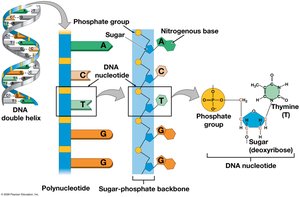
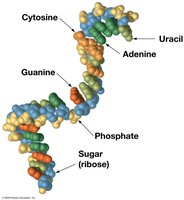
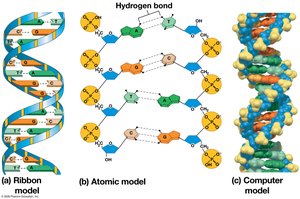
DNA and RNA are nucleic acids composed of long chains (polymers) of nucleotides. Each nucleotide consists of a nitrogenous base, a sugar, and a phosphate group. The sugar-phosphate backbone forms the structural framework of the molecule.
DNA Nucleotides: Adenine (A), Cytosine (C), Thymine (T), Guanine (G)
RNA Nucleotides: Adenine (A), Cytosine (C), Guanine (G), Uracil (U) (replaces Thymine)
Sugar: DNA contains deoxyribose; RNA contains ribose.
Base Pairing and Double Helix
Watson and Crick's model revealed that DNA is a double helix, with two polynucleotide strands held together by hydrogen bonds between complementary bases. The base-pairing rules are:
A pairs with T (and T with A)
G pairs with C (and C with G)
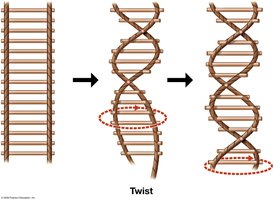
The double helix resembles a twisted ladder, with the sugar-phosphate backbones as the sides and base pairs as the rungs.
DNA Replication
Mechanism of Replication
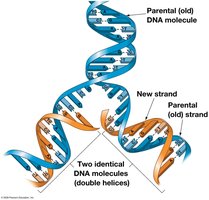
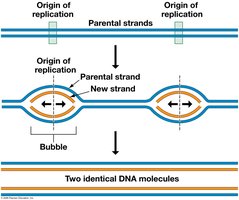
When a cell divides, it must duplicate its DNA so that each daughter cell receives a complete copy. Each strand of the DNA double helix serves as a template for the synthesis of a new complementary strand, following the base-pairing rules.
Enzyme: DNA polymerases catalyze the formation of covalent bonds between nucleotides and repair damaged DNA.
Origins of Replication: Replication begins at specific sites and proceeds in both directions, forming replication bubbles.
From DNA to RNA to Protein
Genotype and Phenotype
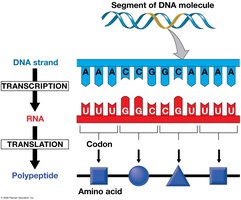
The genotype (genetic makeup) is encoded in the sequence of DNA bases. The phenotype (physical traits) results from the actions of proteins synthesized according to instructions in DNA.
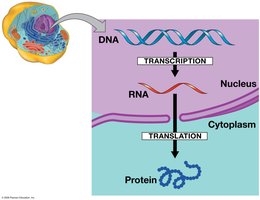
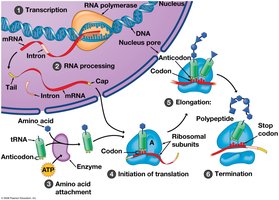
Transcription: DNA is transcribed into RNA in the nucleus.
Translation: RNA is translated into a polypeptide (protein) in the cytoplasm.
The Genetic Code
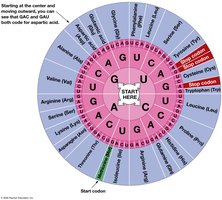
The genetic code consists of three-base codons in RNA, each specifying an amino acid. Of the 64 possible codons, 61 code for amino acids and 3 are stop codons.
Universality: The genetic code is nearly universal among all organisms.
Application: Allows genetic engineering by transferring genes between species.
Transcription: From DNA to RNA
Phases of Transcription
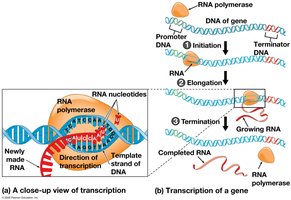
Transcription is the process by which genetic information in DNA is transferred to RNA. It occurs in three phases:
Initiation: RNA polymerase binds to the promoter region and starts RNA synthesis.
Elongation: The RNA strand grows and separates from the DNA template.
Termination: RNA polymerase reaches a terminator sequence, detaches, and the DNA strands rejoin.
Processing of Eukaryotic RNA
RNA Modification and Splicing
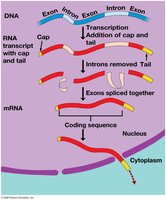
In eukaryotes, RNA transcripts are processed before translation. This includes:
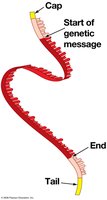
Cap and Tail: Extra nucleotides added to the ends of mRNA for stability and export.
Introns and Exons: Introns (noncoding regions) are removed, and exons (coding regions) are joined by RNA splicing.
Alternative Splicing: Allows a single gene to produce multiple polypeptides.
Translation: From RNA to Protein
Key Players in Translation
Translation converts the nucleic acid language of mRNA into the amino acid language of proteins. It requires:
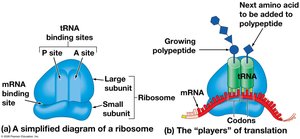
Messenger RNA (mRNA): Carries genetic information from DNA.
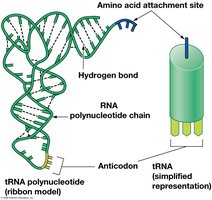
Transfer RNA (tRNA): Matches amino acids to codons via its anticodon.
Ribosomes: Organelles that coordinate mRNA and tRNA to synthesize polypeptides.
Phases of Translation
Translation occurs in three phases:
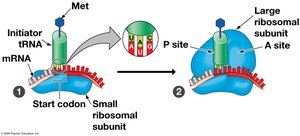
Initiation: mRNA, initiator tRNA, and ribosomal subunits assemble.
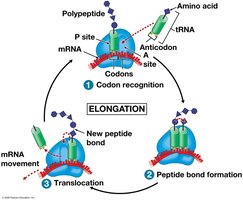
Elongation: Amino acids are added one by one to the growing polypeptide.
Termination: A stop codon signals the end, and the polypeptide is released.
Mutations
Types and Effects of Mutations
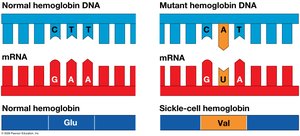
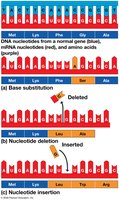
Mutations are changes in the nucleotide sequence of DNA. They can affect large regions or single nucleotide pairs. Types include:
Nucleotide Substitutions: May cause missense (change amino acid) or nonsense (create stop codon) mutations.
Insertions/Deletions: Cause frameshift mutations, often resulting in nonfunctional proteins.
Viruses and Noncellular Infectious Agents
Virus Structure and Reproduction
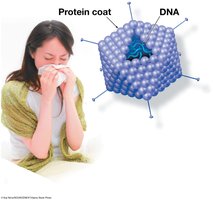
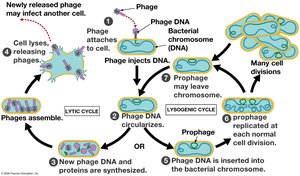
Viruses are infectious particles composed of nucleic acid (DNA or RNA) enclosed in a protein coat, sometimes with a membrane envelope. They are not considered alive because they are not cellular and cannot reproduce independently.
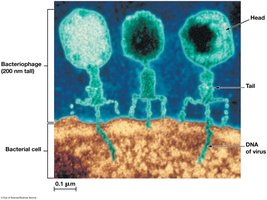
Bacteriophages: Viruses that infect bacteria, reproducing via lytic or lysogenic cycles.
Plant Viruses: Often RNA viruses; can stunt growth and reduce crop yields.
Animal Viruses: Cause diseases such as influenza, measles, AIDS, and polio.
Emerging Viruses and Vaccines
Emergence and Prevention
Emerging viruses, such as SARS-CoV-2 (COVID-19) and West Nile virus, arise through mutation, host species transfer, or epidemic spread. Vaccines, including DNA and RNA vaccines, are developed to prevent viral infections by stimulating the immune system to produce protective proteins.
Retroviruses: HIV is a retrovirus that uses reverse transcriptase to synthesize DNA from RNA.
Prions: Infectious proteins causing brain diseases by inducing misfolding of normal proteins.
Additional info: Understanding molecular biology and evolutionary processes is essential for combating emerging viruses.
